Sunday, July 7, 2013

July 8: "Lean on Me"

On this date in History .... July 8, 1972:

Bill Withers
Bill Withers has his first #1 hit song, “Lean on Me”.  

Withers was the youngest of six children born in a coal mining town in West Virginia. After serving nine years in the navy, he moved to Los Angeles to pursue a music career. Even though he had a song win a Grammy (“Ain’t No Sunshine (when I’m gone)”), he stayed with his factory job in an airplane plant, assembling toilet seats because he felt the music industry was “fickle”. He was still working there when he wrote “Lean on Me”.

 It was the title and theme song of a true-story movie of high school principal Joe Clark.   (Click HERE to see a clip of the movie scene when the song is sang.

The song has been recorded by numerous other artists and even hit the unofficial “Animated Hall of Fame” when it was used on an episode of the Simpsons.


July 7: "The Stripper"

On this date in History ... July 7, 1962:

David Rose’s composition “The Stripper” became a #1 hit. 

Rose wrote the 1 minute 55 second tune as a throwaway background piece while working on a short-lived TV show, “Burlesque”.  He pressed a few vinyl copies as gag gifts for orchestra members and then forgot about it.  

Four years later, MGM records pulled it out of archives for a “B” side of another or Rose’s musical pieces. A Los Angeles DJ discovered the “B” side song and thought it so funny, he played it all day.  It quickly became a regional, then national hit.  

(Many of us never knew the actual name of this song ….. we thought of it as “The Noxema Song” because of its use on Noxema shaving commercials, as seen in this clip!)


Saturday, July 6, 2013

July 6: McCartney Meets Lennon

On this date in History ... July 6, 1957: 

Paul McCartney is introduced to John Lennon for the first time.  

Lennon and his band, Quarry Men Skiffle Group, were scheduled to play at a church function, added as a last minute entertainment due to the large crowd of teenagers attending.  15-year-old McCartney showed up with a friend and while Lennon was not the best guitar player nor could he remember all of the words to the songs, McCartney noticed how he had the audience enthralled.  After the show, McCartney’s friend got them space to hang out with the band and McCartney pulled out his guitar and began playing some Little Richard numbers and other songs.  Lennon “recognized in Paul the same passion” Paul had seen in Lennon earlier. 

Two weeks later, Lennon invited Paul to join The Quarry Men and the rest, as they say, is rock and roll history.

.

Friday, July 5, 2013

July 5: Marital Rape Becomes Illegal

On this date in History .... July 5, 1993:

Marital rape became a crime in all 50 states when North Carolina became the last state to pass such a law.  The first spousal rape law was passed in North Dakota in 1975. 

The definition of rape was most commonly defined as “sex with a woman, not his wife, without her consent.”  The “logic” goes back to 17th century England when a Chief Justice gave the opinion that once married, a woman “hath given herself in kind to her husband which she cannot retract”, in effect ruling that once married, a woman does not have the right to refuse sex with her husband.  This remained unchallenged for over 300 years until the feminist movement of the 1970s when women argued this failed to provide equal protection under the law for all women. 

For a much longer writing of the horrors of these marital rape laws, see my blog at:


.

Thursday, July 4, 2013

July 4: Indianapolis War Memorial

On this date in History .. July 4, 1927:  


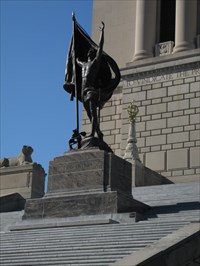
General John Pershing lays the cornerstone to the Indiana War Memorial Museum Building in Indianapolis Indiana. 


It was originally built to honor veterans of WWI and is modeled after the Mausoleum at Halicarnassus, one of the seven wonders of the world, built in 350 BC. 


There are over 400 military flags in the museum, 300 of which are from the Civil War. 

The Indiana War Memorial Plaza Historic District in downtown Indianapolis covers a 5-block area, has 24 acres of memorials, fountains , sculptures and statues, making Indianapolis “… 2nd only to Washington DC in acreage and number of monuments dedicated to veterans.” 


The south side of the museum has a 24’  bronze sculpture by Henry Hering, which at the time was the largest sculpted bronze casting ever made in in America. 

Admission is free to this incredible monument & museum.


.

Monday, July 1, 2013

July 2: Song "Taps" is played

On this date in History ... July 2, 1862:

The song “Taps” is played for the first time. 

Civil War general Daniel Butterfield (later a Medal of Honor recipient) modified the current “Lights Out” bugle call that signaled the end of the day as it felt it was too formal.  Working with his bugler, Oliver Norton, the 24-note song was modified and played, the sounds drifting over to other Army units. Buglers from those units came to Norton and asked for the music.  Without any official command to do so, the song drifted into Army units, used by Union and Confederate units alike.  

The song was officially recognized by the U.S. Army in 1874.  The first Taps played at a military funeral was by Captain John Tidwell in July 1862 when his cannoneer was killed but with the enemy so close, Tidwell feared the military traditional firing of three cannon shots would incite enemy fire.  


It is played nightly at the Tomb of the Unknown Soldier. 


General Butterfield died in 1901. Even though he never attended West Point, his tomb is the most ornate in the West Point cemetery.

While there are no official lyrics for Taps, the following unofficial verse (author unknown) is often used:

    Fading light dims the sight,
    And a star gems the sky, gleaming bright. 

    From afar drawing nigh -- Falls the night.
    Day is done, gone the sun,
    From the lake, from the hills, from the sky; 

    All is well, safely rest, God is nigh.
    Then good night, peaceful night,
    Till the light of the dawn shineth bright;
    God is near, do not fear -- Friend, good night.

July 1: "Death Tax" passed

On this date in History .... July 1, 1862:

Congress passes what develops into an Estate Tax: A duty/tax on certain "legacies or distributive shares arising from personal property" passing, either by will or intestacy, from deceased persons.” 

This was part of the tax structure implemented by Lincoln to cover the cost of the Civil War. (Ironic observation: a tax passed that will tax the transfer of assets when a person dies …. during the war that killed more Americans than any other war.) 

The modern estate tax was passed Sept 8, 1916. 

The term “death tax” was coined in the 1940s, which is a term that relates back to the original use of the term “death duties”. A political pollster wrote that “the term ‘death tax’ kindled voter resentment in a way that 'inheritance tax' and 'estate tax' do not".  

According to the New York Times (in 2006), “Estate tax lawyers are the most productive tax law enforcement personnel at the IRS… For each hour they work, they find an average of $2,200 of taxes that people owe the government.”

.