Showing posts with label black history. Show all posts

Wednesday, March 3, 2021

ELIZABETH KECKLEY - Seamstress in the White House

 On this date in history - March 4, 1861 - 


Elizabeth Keckley meets Mary Todd Lincoln on the day of Lincoln’s first 
Inauguration and ended up becoming Mrs. Lincoln’s dressmaker and companion.  Keckley was born a slave, owned by her father. She became a nursemaid to her master’s baby when she was 4 or 5. Her mother, a domestic servant and seamstress, was well liked by the family and was allowed to be taught to read and write. She taught these skills to her daughter Elizabeth.  

The white family had multiple financial problems and Elizabeth’s sewing skills were eventually used to make money for the family and their 17 children.  She offered to give all of her money to her owner in exchange for not hiring out Elizabeth’s aged mother for extra money as they were on the verge of bankruptcy.  Soon other white women were coming to her for their dresses. 

She found supporters who helped her buy her and her only son’s freedom, then moved to Washington DC. where she found it hard to set up a business unless she could find a white person to vouch that she was really free.  A client helped put her in touch with a few influential people, including Varna Davis, the wife of soon-to-be Confederate President Jefferson Davis.  Davis encouraged Elizabeth to come with her to the South “….as a war will soon be upon us.”  Elizabeth declined.  

The Lincolns soon arrived in DC to get ready for Lincoln’s inauguration.  A DC woman needed a dress made for a social meeting she had with the Lincolns,  but Elizabeth turned it down due to the late notice.  The customer told her “I have often heard you say that you would like to work for the ladies of the White House. Well, I have it in my power to obtain you this privilege. I know Mrs. Lincoln well, and you shall make a dress for her provided you finish mine in time to wear at dinner on Sunday.” 

The dress was made and Elizabeth was introduced to Mary Todd Lincoln.  They developed a strong business and personal relationship.  Elizabeth’s only son, George, a Union soldier, was killed in battle about six months before Willie Lincoln died.  Two mothers mourning the death of their sons bonded Elizabeth and Mary Lincoln even closer.  When Lincoln was shot, Mary Lincoln cried out for Elizabeth to be brought to her side for comfort. 

In 1868, Elizabeth wrote a book about her years in the White House, Behind the Scenes or Thirty Years a Slave, Four Years in the White House, believing it would  help “redeem her own character as well as Mrs. Lincoln’s.”  There had been great controversy about Mrs. Lincoln’s decision to try to sell some of her clothes to raise money and Elizabeth had helped with this project.

“By writing down the story of her enslavement, her intimate conversations with Washington’s elite women, and her relationship with Mary Lincoln, Keckly violated social norms of privacy, race, class, and gender.  Although other formerly enslaved people like Frederick Douglass wrote generally well received memoirs during the same time period…..” , the book by Elizabeth, a black woman, seemed to enrage the public, with some pointing this as a reason black women should not be educated.

Mrs. Lincoln felt “betrayed by the intimate details” and never spoke to Elizabeth again. Elizabeth’s customers began disappearing and she began training other seamstresses. “In 1892, she accepted a position as the head of Wilberforce University’s Dept of Sewing and Domestic Science Arts.”  She died May 26, 1907, at the age of 89, a t the National Home for Destitute Colored Women and Children.

Tuesday, June 16, 2015

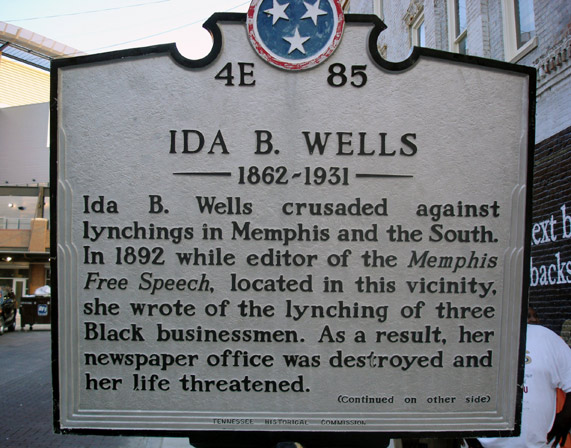
May 4: Ida B. Wells

On this date in History .... May 4, 1884:

Ida B. Wells, a schoolteacher, was sitting in a woman’s railroad car, reading, when the conductor ordered her to move to the “Jim Crow” car. She refused, saying that was a smoking car and she was in the ladies car.  When the conductor grabbed her, she “sunk her teeth” into his arm.  

The 1875 Civil Rights Act had banned discrimination based on race on transportation but in 1883, the Supreme Court declared this act unconstitutional.  The ruling said Congress did not have the power to void discrimination acts by individuals as it did on state action or laws  “Private acts of racial discrimination were simply private wrongs that the national government was powerless to correct”.

When she sued the railroad for her treatment, her attorney was paid off by the railroad, so she hired a white attorney and won a $500 settlement.  The judge says she was indeed a lady.  She was a schoolteacher and was “dressed accordingly.”  Her victory was overturned by the Tennessee Supreme Court.  Ms. Wells went on to be a civil rights activist by being a journalist. 

As a journalist, she became aware that the new black middle class was at risk when three of her friends were lynched.  Before this, she had thought such lynchings, while deplorable, were targeted at those in the lower class who may have been involved in activities that merited a kind of punishment.  Her eyes were then opened to see that lynchings were a way to “get rid of negroes who acquired wealth and property and thus keep the race terrorized…..”


Sources include: 

Sunday, March 16, 2014

March 16: First Black Owned Newspaper

On this date in History .... March 16, 1827


Freedom’s Journal became the first black-owned and operated newspaper in the United States, established the same year that slavery was abolished in New York state.  The paper’s primary purpose was to counter the other pro-slavery and racist papers already in publication. The editors began their first publication with the words, “We wish to plead our own cause. Too long have others spoken for us. Too long has the publick (sic) been deceived by misrepresentations, in things which concern us dearly."  

It not only provided local and national news but also published weddings, birth and death announcements, job postings for African Americans and profiled successful African-Americans such as Phyllis Wheatley (first published black poet). Its two-year existence helped over forty black-owned newspapers become established by the Civil War.  

All issues of the paper can be found at the Wisconsin Historical Society (this link): http://www.wisconsinhistory.org/libraryarchives/aanp/freedom/

Tuesday, August 6, 2013

August 6: Lincolns signs Confiscation Act

On this date in History .... August 6, 1861:  

Lincoln signs the Confiscation Act, the first legislative act toward emancipation of slaves. 

The Act recognized that slaves doing the work on a plantation were freeing up the white Southerners to have plenty of time to fight in the war.  Slaves were also used for menial tasks in the war, also enabling the war effort.  

The Act stripped slave owners of any claim to slaves and made them “confiscated property” of the United States.  The Act stated that any slave who worked for “disloyal masters in some form of work against the United States” were free. 

The law was not enforced uniformly with some Union officers returning slaves back over Confederate lines.  Union (Democrat) Gen’l McCook was so “obliging” in returning slaves to their owners that he was praised in Confederate newspapers.

Tuesday, July 23, 2013

July 23: The Real McCoy

On this date in History ... July 23, 1872:

Elijah McCoy is issued patent #129843 for an “Improvement in Lubricators for Steam Engines”.  

McCoy was the son of former slaves who escaped from Kentucky through the Underground Railroad. His reputation on his multiple patented items was so great that people would ask, when buying equipment, if it was “the real McCoy” or an imitation. 50 of his patents dealt with lubricating machines. 

In Booker T. Washington’s 1909 book “The Story of the Negro”, he cited McCoy as having produced more patents than any other black inventor up to that time. 

.

Saturday, June 29, 2013

June 28: Supreme Court rules on Muhammad Ali

On this date in History ... June 28, 1971:

The Supreme Court unanimously overturned the lower courts in “Clay vs. the United States” in boxer Muhammad Ali’s (Cassius Clay) refusal to be drafted.  Clay had refused, based on his conversion to Islam, to go to Vietnam and shoot people "who never called me nigga....."

Ali would go on to become the first and only 3-time lineal World Heavyweight Champion. He won an Olympic Gold Medal in 1960 (his amateur records was 100 wins with 5 losses). Legend has it that he threw the medal in the Ohio River after being refused service in a whites-only restaurant. He was presented with a replacement medal at the 1996 Olympics, where he lit the torch to start the games.  

In 1993, the Associated Press reported that Ali was tied with Babe Ruth as the most recognized athlete, out of over 800 dead or alive athletes, in America. The study found that over 97% of Americans over 12 years of age identified both Ali and Ruth.


Wednesday, June 19, 2013

June 18: Slave Owner Sues for Property

On this date in History ... June 18, 1825: 

Samuel Todd of Kentucky sued William Bulla and Bulla's father-in-law, Andrew Hoover,  both from Wayne County, Indiana, for $500.00 each for loss of property. Todd accused the men of helping his slave Peter escape. 

Peter fled Kentucky in August of 1821 and came to Indiana. He was found in 1825 just north of Richmond, a town on the Indiana/Ohio state line, and had changed his name to George Stellow. While the slave hunter went to the Justice of the Peace, asking him to approve Peter’s removal back to Kentucky, a group of people broke Peter out of jail with “bodily force and violence”.  

With Peter was gone, Todd had no other recourse and he sued Bulla and Hoover, who he believed to be responsible for the loss of property. The judge ordered both men to pay the plaintiff to recover his own debt and costs, a total of $1,500.00.  The lawsuit was handled in federal court because of "Diversity of Citizenship", that is when a person from one state sued a person in another state, the issues was moved to a federal court so that one's own state wouldn't have a biased ruling.

While the information does not specify exactly where "north of Richmond" might be, we might speculate that it could be a tiny town of Newport (today named "Fountain City"), Indiana.  In 1826, Levi Coffin and his wife Catherine moved to Newport and built their home and business.  Coffin would eventually become known as the Grand Master Conductor of the Underground Railroad.  For Peter to live a number of years in this Quaker, abolitionist area is not surprising.

However, William Hoover is reported to have lived near the "middle fork" of the Whitewater RIver less than two miles north of Richmond.  Today, Richmond's water is supplied by the Middlefork Reservoir.

Source for this article: http://www.in.gov

.


Friday, June 14, 2013

June 15: Bessie Coleman

On this date in History .... June 15, 1921:


Bessie Coleman became the first African American woman to earn an aviator’s license and the first American of any race or gender to receive an International Aviation License. 

No one in the U.S. would teach her to fly because she was (a) a woman and (b) black so she had to go to France for lessons.  She became a “barnstormer” show pilot and an immediate media sensation when she returned to the U.S.  She encouraged other African Americans to learn to fly but refused to perform at locations that would not admit those of her race.


Photo courtesy of civilrights.si.edu 
“She was invited as a guest of honor to attend the all-black musical ‘Shuffle Along.’ The entire audience, including the several hundred whites in the orchestra seats, rose to give the first African American female pilot a standing ovation.” (quote source: pbs.org).  

Coleman died in a plane accident at the age of 34 when an unsecured wrench got caught in the control gears and she fell to her death. For a number of years, starting in 1931, Chicago pilots had an annual fly-over of her grave. 

.

Wednesday, June 12, 2013

June 13: Thurgood Marshall

On this date in History .... June 13, 1967:

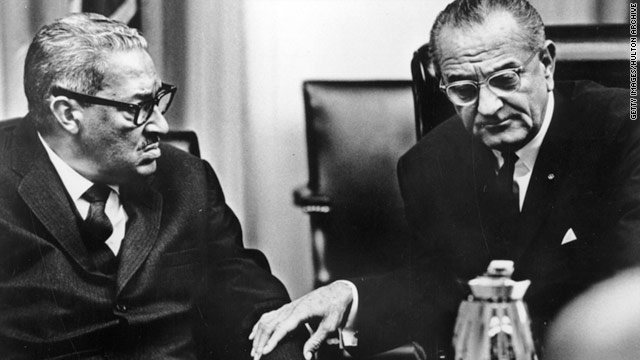
Lyndon Johnson nominated Thurgood Marshall for the U.S. Supreme Court.  

Marshall was confirmed by Congress 69-11 and sworn in on August 30, making him the first African-American to sit on the Supreme Court. 

The great-grandson of slaves, he became an attorney and argued cases before the Supreme Court, winning 29 of them, including the ground breaking Brown v. Board of Education in 1954. 

He served 24 years on the Court.

.

June 12: Interracial Marriage Now Legal

On this date in History ..... June 12, 1967:

The Supreme Court overturned the conviction of Loving v. Virginia making it illegal to ban interracial marriage. 

In addition to being guilty of an interracial marriage, Mildred and Richard Loving were also guilty of violation of Virginia law of interracial couples marrying in another state (Wash DC) and moving back to Virginia. 

Law enforcement stormed into their bedroom, shined lights in their eyes and hauled them off to jail.  They were told they could avoid the one year in prison if they left the state and never returned.  The couple decided to fight it and took it all the way to the Supreme Court.

Nine years later, the Supreme Court concluded that anti-miscegenation laws were racist and had been enacted to perpetuate white supremacy: “….The fact that Virginia prohibits only interracial marriages involving WHITE persons demonstrates that the racial classifications must stand on their own justification, as measures designed to maintain White Supremacy.” 

Despite this Supreme Court ruling, such laws remained on the books, although unenforceable, in several states until 2000, when Alabama became the last state to repeal its law against mixed-race marriage.


Thursday, May 23, 2013

May 23: William Harvey Carney

On this date in History ... May 23, 1900:  

Sergeant William Harvey Carney is belatedly awarded the Congressional Medal of Honor for his bravery on July 18, 1863, while fighting for the Union cause as a member of the 54th Massachusetts Colored, becoming the first African American to perform actions that merited the Medal of Honor, the nation’s highest military honor. Here is his amazing story (which gives me chills every time I tell it!!!):  

“The Civil War was almost two years old when President Abraham Lincoln issued the Emancipation Proclamation on January 1, 1863. With that historic step, for the first time, black American's were encouraged to enlist in the Union Army. Among the enlistees was a young man named William Carney.” 

At the battle at Ft. Wagner, in South Carolina (this battle was depicted in the movie "Glory" (in this clip) ), the Sergeant. carrying the flag was shot. Carney grabbed the flag before it could hit the ground. With a gunshot wound in his leg, he carried the flag & led the advance to the Confederate fort, gaining entrance & planting the Stars and Stripes. Too late, he realized he was alone. Everyone else in his platoon had been killed or wounded. As he was approached by Confederate soldiers, rather than drop the flag and flee for his life, he wrapped the flag tight and ran down an embankment. In chest high water, with the flag held high, he was shot in the chest, the arm and the leg. He continued to struggle forward even when another bullet grazed his head.  

“From the safety of the distance to which they had retreated, what remained of the valiant warriors of the 54th Massachusetts Colored Infantry watched the brave Sergeant struggle towards safety. A retreating member of the 100th New York passed Carney and, seeing the severity of his wounds said, "Let me carry that flag for you." With indomitable courage Sergeant Carney replied, "No one but a member of the 54th should carry the colors." Despite the sounds of rifle and cannon fire that followed him, Carney struggled on. Another enemy bullet found its mark, grazing his head, but Carney wouldn't quit.”  

When he reached safety, collapsing from his wounds, he said, “Boys, I only did my duty.  The flag never touched the ground.”

And with those words, William Harvey Carney, who had been born a slave, whose father had purchased his freedom when he was 15 years old, who had joined the Union Army shortly after President Lincoln signed the bill that allowed him to join, who wanted to fight to preserve the country that had enslaved him, William Harvey Carney, that day, became the first African American to earn the country's highest honor, the Medal of Honor.


Sources for this story include:  http://www.homeofheroes.com/hallofheroes/1st_floor/flag/1bfa_hist5carney.html  
http://www.cmohfoundation.org/documents/myths-and-little-known-facts/  
http://www.history.com/this-day-in-history/forgotten-civil-war-hero-honored  
http://www.historynet.com/william-h-carney-54th-massachusetts-soldier-and-first-black-us-medal-of-honor-recipient.htm


Saturday, April 13, 2013

April 13: Hudner Receives Medal of Honor


On this date in History …. April 12, 1951:


Lt. Thomas Hudner is awarded the Medal of Honor for intentionally crashing his plane into a mountain to try to save U.S. Navy Ensign Jesse Leroy Brown, the first African-American Navy pilot.  Hudner was sure his career was over when he crashed “a perfectly good plane” in an attempt to save a black man. 


At a very young age, Jesse knew he wanted to be an aviator so he worked hard in school, graduated second in his class at Eureka High School.  The was then accepted at Ohio State and became one of the 1% African-American population in that college. When he entered Navy pilot school, he was the only African-American in a class of 600.


While on one of many flying missions, during the Korean War, to support and protect the U.S.S. Leyte, his plane was hit and losing oil pressure.  He crash landed on a snowy mountain, 5300 feet in elevation. While he was able to open the hatch and wave to the other pilots to send help, he was unable to leave the plane as his legs were pinned by the wreckage.

The other pilots worked to protect Brown from the hordes of Chinese in the area, but after half an hour, Lt. Hudner decided to kick it up a notch. Without alerting or asking permission from his commander, Hudner turned his plane into the wind to slow down his speed and crashed his plane about a 100 yards from Brown.  Hudner said years later, about this decision:

“I knew what I had to do. I was not going to leave him down there for the Chinese. Besides, it was 30 degrees below zero on that slope, and he was a fellow aviator. My association with the Marines had rubbed off on me. They don’t leave wounded Marines behind.”

Rescue helicopters arrived with axes to try to get Brown out of the wreckage.  In addition to fighting extreme cold temperatures, there was also smoke coming from the wreckage.  Hudner threw snow on the fire, but only managed to somewhat control it but unable to put it out.  Darkness was falling and the helicopters were not equipped to fly at night.  Brown was barely conscious and still trapped.  The last thing he said to Hudner was “Tell my wife Daisy I love her.”  The rescue team was forced to fly off and the order came down from their commander for an air strike to napalm the crash site, cremating the frozen body of Ensign Brown.

“Hudner after the failed rescued figured he would be reprimanded and his Naval career ended for crashing a perfectly fine Corsair aircraft in a failed attempt to save one man, a black man at that. However, Lieutenant Hudner’s command did something totally unexpected, they instead recommended him for the nation’s highest combat award, the Medal of Honor. Additionally the deceased Ensign Brown was awarded the second highest honor for combat pilots, the Distinguished Flying Cross.”  (source: www.rokdrop.com)

When Hudner received his Medal of Honor at the White House, there was one lone African American woman standing next to him.  Daisy Brown, the wife of Ensign Brown, watched as Hudner received the medal for his heroic attempts to save her husband and she received the last message from her husband, “Tell Daisy I love her.”

In 1972 a destroyer was named the USS Jesse L. Brown.  Daisy and Thomas Hudner were there for the christening ceremony.

Monday, March 4, 2013

March 4: Robert Smalls

On this date in History .... 1875:

Robert Smalls joins the House of Representatives from South Carolina’s 5th District. A former slave, he was the last Republican to represent the district until 2010.
 
“As a politician, Smalls authored state legislation providing for South Carolina to have the first free and compulsory public school system in the United States, and founded the Republican Party of South Carolina. He is notable as the last Republican to represent South Carolina's 5th congressional district until 2010.”

The first ten years of his life were relatively easy.  It is rumored that his master, Henry McKee, was his father. Smalls was taken around town by McKee and he was permitted to play with other children, black and white.  This bothered his slave-mother who made sure he saw and understood the horrors of the life of slavery.  She made him sleep on the earthen floor, not on a cot. She made him work in the fields, pick cotton, and wear tattered clothes like other slaves. She even took him to watch the activities at the whipping post so he could truly understand what it was like to be a slave.

As a 12-year old slave, his master sent him to Charleston to be hired out on ships where he gained a high level of knowledge about ships and the Charleston harbor.  While on the USS Planter, he planned and executed a daring escape, disguising himself as the ship’s captain and even stopping to pick up his family. He used the correct Confederate signals to get past the Confederate ships.  He then raised a white sheet as a flag and headed straight for the Union fleet.  He turned the ship and its contents, which included a copy of the Confederate code book and locations of mines in the harbor, over to the Union Army.

Congress passed a bill, signed by Lincoln, enabling Smalls and his other “Negro crew members” to receive the prize money for turning over the Confederate ship (about $1500).  He met Lincoln himself just a couple of weeks later.  Because of the debate on allowing African Americans to join the military, Smalls served in the Union Army as a civilian.

"In December 1863, Smalls became the first black captain of a vessel in the service of the United States. On December 1, 1863, the Planter had been caught in a crossfire between Union and Confederate forces. The ship's commander, Captain Nickerson, decided to surrender. Smalls refused, fearing that the black crewmen would not be treated as prisoners of war and might be summarily killed. Taking command, Smalls piloted the ship out of range of the Confederate guns. For his bravery, Smalls was named to replace Nickerson as the Planter's captain. Smalls returned with the Planter to Charleston harbor in April 1865 for the ceremonial raising of the American flag upon Ft. Sumter."  (Quote Source: Wikipedia)


After the war, he returned to the South and purchased his former master’s house.  His mother lived with him for the rest of her life and he even permitted his previous master’s wife to live with them in the house prior to  her death.  The home as been designated as a National Historic Landmark.