Showing posts with label Civil War. Show all posts

Wednesday, March 3, 2021

ELIZABETH KECKLEY - Seamstress in the White House

 On this date in history - March 4, 1861 - 


Elizabeth Keckley meets Mary Todd Lincoln on the day of Lincoln’s first 
Inauguration and ended up becoming Mrs. Lincoln’s dressmaker and companion.  Keckley was born a slave, owned by her father. She became a nursemaid to her master’s baby when she was 4 or 5. Her mother, a domestic servant and seamstress, was well liked by the family and was allowed to be taught to read and write. She taught these skills to her daughter Elizabeth.  

The white family had multiple financial problems and Elizabeth’s sewing skills were eventually used to make money for the family and their 17 children.  She offered to give all of her money to her owner in exchange for not hiring out Elizabeth’s aged mother for extra money as they were on the verge of bankruptcy.  Soon other white women were coming to her for their dresses. 

She found supporters who helped her buy her and her only son’s freedom, then moved to Washington DC. where she found it hard to set up a business unless she could find a white person to vouch that she was really free.  A client helped put her in touch with a few influential people, including Varna Davis, the wife of soon-to-be Confederate President Jefferson Davis.  Davis encouraged Elizabeth to come with her to the South “….as a war will soon be upon us.”  Elizabeth declined.  

The Lincolns soon arrived in DC to get ready for Lincoln’s inauguration.  A DC woman needed a dress made for a social meeting she had with the Lincolns,  but Elizabeth turned it down due to the late notice.  The customer told her “I have often heard you say that you would like to work for the ladies of the White House. Well, I have it in my power to obtain you this privilege. I know Mrs. Lincoln well, and you shall make a dress for her provided you finish mine in time to wear at dinner on Sunday.” 

The dress was made and Elizabeth was introduced to Mary Todd Lincoln.  They developed a strong business and personal relationship.  Elizabeth’s only son, George, a Union soldier, was killed in battle about six months before Willie Lincoln died.  Two mothers mourning the death of their sons bonded Elizabeth and Mary Lincoln even closer.  When Lincoln was shot, Mary Lincoln cried out for Elizabeth to be brought to her side for comfort. 

In 1868, Elizabeth wrote a book about her years in the White House, Behind the Scenes or Thirty Years a Slave, Four Years in the White House, believing it would  help “redeem her own character as well as Mrs. Lincoln’s.”  There had been great controversy about Mrs. Lincoln’s decision to try to sell some of her clothes to raise money and Elizabeth had helped with this project.

“By writing down the story of her enslavement, her intimate conversations with Washington’s elite women, and her relationship with Mary Lincoln, Keckly violated social norms of privacy, race, class, and gender.  Although other formerly enslaved people like Frederick Douglass wrote generally well received memoirs during the same time period…..” , the book by Elizabeth, a black woman, seemed to enrage the public, with some pointing this as a reason black women should not be educated.

Mrs. Lincoln felt “betrayed by the intimate details” and never spoke to Elizabeth again. Elizabeth’s customers began disappearing and she began training other seamstresses. “In 1892, she accepted a position as the head of Wilberforce University’s Dept of Sewing and Domestic Science Arts.”  She died May 26, 1907, at the age of 89, a t the National Home for Destitute Colored Women and Children.

Wednesday, April 2, 2014

March 17: John Pelham

On this date in History .... March 17, 1863:  

John Pelham, age 24, dies at the battle of Kelleysville while standing in his horse stirrups, crying out “Press forward, press forward to glory & victory!” Pelham was considered one of the greatest officers of the Confederate Army, his artillery precision unsurpassed. He left West Point just short of graduating to join the Confederate military.

Gen. Stonewall Jackson said, “With a Pelham on each flank I believe I could whip the world.” Many southern towns are named after him & Gen. J.E.B. Stuart named his daughter after Pelham. 

Pelham's greatest battle was at Fredericksburg where he confused a federal army of 120,000 men with his brilliant one-gun barrage from their flank. His contribution to the Confederate victory that day was a major one and General Robert E. Lee cited the part played by "the gallant Pelham" in his official report    (source: http://www.usa-civil-war.com/Civil_War/pelham.html)


Tuesday, August 6, 2013

August 6: Lincolns signs Confiscation Act

On this date in History .... August 6, 1861:  

Lincoln signs the Confiscation Act, the first legislative act toward emancipation of slaves. 

The Act recognized that slaves doing the work on a plantation were freeing up the white Southerners to have plenty of time to fight in the war.  Slaves were also used for menial tasks in the war, also enabling the war effort.  

The Act stripped slave owners of any claim to slaves and made them “confiscated property” of the United States.  The Act stated that any slave who worked for “disloyal masters in some form of work against the United States” were free. 

The law was not enforced uniformly with some Union officers returning slaves back over Confederate lines.  Union (Democrat) Gen’l McCook was so “obliging” in returning slaves to their owners that he was praised in Confederate newspapers.

August 5: Lincoln signs Tax Bill

On this date in History .... August 5, 1861:  

Lincoln signs the Revenue Act, imposing a 3% tax on incomes over $800 (comparable to $30,000 +/- in 2010 dollars) to pay for the Civil War.  He asked multiple Cabinet members about his constitutional authority to impose such a tax.  Lincoln’s tax law was repealed in 1871 but was replaced in 1909 by the 16th amendment (ratified in 1913) which set in place the income tax system we all “enjoy” today.


Sunday, August 4, 2013

August 4: Gov. Oliver P. Morton

On this date in History .... August 4, 1823:  


Gov. Oliver Morton
Photo courtesy of
www.nps.gov
Oliver Perry Throck Morton is born in Salisbury (Wayne County) Indiana. (Salisbury no longer exists but was located between Richmond and Centerville on the east side of the state.)  The family name of “Throckmorton” was shortened to “Morton” but the males in the family carried the “Throck” name as a middle name.  

Morton was the first Indiana-born governor and served as the “war-time governor” of Indiana for six years (Jan. 16, 1861–Jan. 23, 1867) and strongly supported the Union during the Civil War. He began his political career as a Democrat but was thrown out of the party because of his anti-slavery stance.  As governor, he raised men and money for the Union army, and successfully suppressed Indiana's Confederate sympathizers.

“Morton immediately dissolved the General Assembly and announced his intent to administer the state without its representatives. As the state approached bankruptcy, Morton successfully solicited the donation and loan of millions of dollars in private money that were then used to fund the government. He continued to harass and suppress the activities of his political opponents whom he occasionally accused of treason. 

It is thought that because of his scrupulous honesty during this period of one-man rule he was able to escape post-war retribution for his actions. He was reelected governor in 1864 and served until his appointment to the U.S. Senate in 1867. “  

During his early tenure as governor, Morton believed that war was inevitable and began to prepare the state for it. He appointed men to cabinet positions who were well known to be against any compromise with the southern states. He established a state arsenal and employed seven hundred men to produce ammunition and weapons without legislative permission and made many other preparations for the war to come.

When open war finally broke out on April 12, 1861, he telegraphed President Abraham Lincoln three days later to announce that he already had 10,000 soldiers underarms ready to suppress the rebellion.

“In 1865, when Morton had a paralytic stroke and went to Europe for treatment, the President entrusted him with a confidential mission to Napoleon III concerning the withdrawal of the French troops from Mexico.”  (quote source: http://www.nndb.com/people/209/000050059/


In 1867, he was elected to the U.S. Senate where he served until his death in 1877.

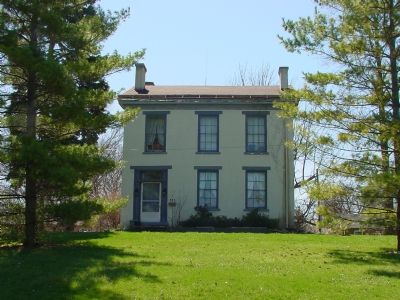
Oliver P. Morton Home, Centerville Indiana.
For more photos, explore this link:
http://www.hmdb.org/Marker.asp?Marker=264 

Sunday, July 21, 2013

July 21: Mary Edward Walker

On this date in History .... July 21, 1861:

Dr. Mary Walker, a Civil War surgeon and the nation's first female surgeon , was awarded the Medal of Honor, for her efforts at Bull Run on July 21,1861, becoming the only woman to receive the Medal of Honor and one of only eight civilians to ever receive it. She was recommended for the medal after the war by General William Tecumseh Sherman. President Andrew Johnson signed his approval in 1865. 

Her name was removed from the honor list of awardees in 1917, along with others, when the terms used to designate eligibility for the award were reappraised. She refused to surrender the medal, however, and continue to wear it for the rest of her life. In 1977, thanks to the efforts of her family and a Congressional reappraisal of her achievements, the honor was restored.

Mary Walker
Dr. Walker was a militant feminist before the word became part of our vocabulary and worked especially hard on "dress reform" as part of women's emancipation.

Born a farmer’s daughter, she did not wear women’s clothing doing farm labor because it was too restricting and refused to “dress as a woman” while doing medical work during the war. The only women in her 1855 medical class, after graduation she married a doctor but kept her own name. She volunteered as a surgeon, working on the front lines.

She refused to wear cumbersome skirts while doing medical work during the Civil War. On April 10, 1864, when she took a wrong turn on a road, she was captured and accused of being a spy since she was “disguised” in men’s clothing, making her the first female POW.  Upon release, she worked in a women’s prison, where the women prisoners didn’t like her wardrobe of long pants and a tunic & asked for a “real” (man) doctor. 

Mary Walker
After the war she became a writer/speaker in the suffrage movement, particularly on the topic of women’s clothing.  She was arrested for impersonating a man several times, although she argued that Congress had awarded her special permission to dress in this way.


.

Monday, July 15, 2013

July 16: 2nd Confiscation Act

On this date in History ... July 16, 1862:

Congress passes the 2nd Confiscation Act to clarify the vague issue of whether slaves were freed under the Confiscation Act of 1861.  

The Act called for any confederate who did not surrender within 60 days would have their slaves freed. There was no action stated for what to DO with the freed slaves, however. The 1862 Act declared that all slaves taking refuge behind the Union lines would be freed. 

The Act did provide a provision for voluntary colonization to a tropical country, but included a clause that required the freedmen to consent to the colonization, a clause that was passed after much controversy in Congress. 

The “emancipation gesture” applied only to rebelling states and any slave owner who could prove loyalty to the Union would get their slaves back.


Wednesday, July 10, 2013

July 11: "In God We Trust"

On this date in History ... July 11, 1956:

In the decades following the Civil War, "In God We Trust" appeared on most coins. Since 1938, the motto has appeared on all American coinage. 

On July 11, 1956, during the height of the Cold War struggle with the officially atheist Soviet Union, Congress passed a joint resolution, signed by President Dwight Eisenhower, declaring "In God We Trust" to be the national motto. 

The following year, on Oct. 1, the motto appeared for the first time on paper currency - on the back of the dollar bill.

Thursday, July 4, 2013

July 4: Indianapolis War Memorial

On this date in History .. July 4, 1927:  


General John Pershing lays the cornerstone to the Indiana War Memorial Museum Building in Indianapolis Indiana. 


It was originally built to honor veterans of WWI and is modeled after the Mausoleum at Halicarnassus, one of the seven wonders of the world, built in 350 BC. 


There are over 400 military flags in the museum, 300 of which are from the Civil War. 

The Indiana War Memorial Plaza Historic District in downtown Indianapolis covers a 5-block area, has 24 acres of memorials, fountains , sculptures and statues, making Indianapolis “… 2nd only to Washington DC in acreage and number of monuments dedicated to veterans.” 


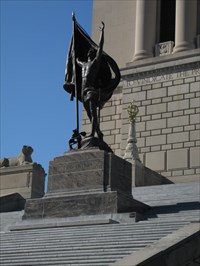
The south side of the museum has a 24’  bronze sculpture by Henry Hering, which at the time was the largest sculpted bronze casting ever made in in America. 

Admission is free to this incredible monument & museum.


.

Monday, July 1, 2013

July 2: Song "Taps" is played

On this date in History ... July 2, 1862:

The song “Taps” is played for the first time. 

Civil War general Daniel Butterfield (later a Medal of Honor recipient) modified the current “Lights Out” bugle call that signaled the end of the day as it felt it was too formal.  Working with his bugler, Oliver Norton, the 24-note song was modified and played, the sounds drifting over to other Army units. Buglers from those units came to Norton and asked for the music.  Without any official command to do so, the song drifted into Army units, used by Union and Confederate units alike.  

The song was officially recognized by the U.S. Army in 1874.  The first Taps played at a military funeral was by Captain John Tidwell in July 1862 when his cannoneer was killed but with the enemy so close, Tidwell feared the military traditional firing of three cannon shots would incite enemy fire.  


It is played nightly at the Tomb of the Unknown Soldier. 


General Butterfield died in 1901. Even though he never attended West Point, his tomb is the most ornate in the West Point cemetery.

While there are no official lyrics for Taps, the following unofficial verse (author unknown) is often used:

    Fading light dims the sight,
    And a star gems the sky, gleaming bright. 

    From afar drawing nigh -- Falls the night.
    Day is done, gone the sun,
    From the lake, from the hills, from the sky; 

    All is well, safely rest, God is nigh.
    Then good night, peaceful night,
    Till the light of the dawn shineth bright;
    God is near, do not fear -- Friend, good night.

July 1: "Death Tax" passed

On this date in History .... July 1, 1862:

Congress passes what develops into an Estate Tax: A duty/tax on certain "legacies or distributive shares arising from personal property" passing, either by will or intestacy, from deceased persons.” 

This was part of the tax structure implemented by Lincoln to cover the cost of the Civil War. (Ironic observation: a tax passed that will tax the transfer of assets when a person dies …. during the war that killed more Americans than any other war.) 

The modern estate tax was passed Sept 8, 1916. 

The term “death tax” was coined in the 1940s, which is a term that relates back to the original use of the term “death duties”. A political pollster wrote that “the term ‘death tax’ kindled voter resentment in a way that 'inheritance tax' and 'estate tax' do not".  

According to the New York Times (in 2006), “Estate tax lawyers are the most productive tax law enforcement personnel at the IRS… For each hour they work, they find an average of $2,200 of taxes that people owe the government.”

.

Tuesday, May 28, 2013

May 28: 54th Massachusetts

On this date in History ... May 28, 1863:  

The 54th Massachusetts, the most famous African-American regiment of the Civil War, departs for combat.  

Five days earlier, the government had established the Bureau of Colored Troops. Most blacks who joined the military were freed or escaped slaves. However, 90% of the Colored Troops officers were white. That day in 1863, the 54th had over 1000 black soldiers and 37 white officers, in spite of the Confederate’s threat that every captured black Union soldier would be sold into slavery and every white officer would be executed.  
Col. Robert Shaw

Colonel Robert Shaw, who was only 25 and had dropped out of Harvard to join the military, led the 54th and chose white officers with abolitionist views.  Shaw was killed in the battle at Fort Wagner, SC, which was depicted in the movie “Glory”.  

This battle was also where we find the story of William Harvey Carney, a member of the 54th and the first black American who earned the Medal of Honor (see my blog posting of May 23). 


Friday, May 24, 2013

May 24: Elmer Ellsworth - 1st Civil War Casualty

On this date in History .... May 24, 1861:  

Add caption
Elmer Ellsworth, 24 years old and a personal friend of Abraham Lincoln, became the first conspicuous casualty of the American Civil War.  

The day after Virginia ratified the decision to secede from the Union, Ellsworth and his troops entered Alexandria, Virginia.  There was an 8x14 foot Confederate flag being flown over an inn. The flag was big enough to be seen through a spyglass from the White House. Ellsworth felt getting that flag down would help avoid any problems. 

When he approached the inn with four soldiers with him, the innkeeper, a strong proponent of slavery, shot Ellsworth at point blank range, killing him instantly. Since Ellsworth was a personal friend of Lincoln, his body lay in state in the White House.  

Corporal Francis Brownell, who had killed the innkeeper for shooting Ellsworth, was eventually awarded the Medal of Honor.


Thursday, May 23, 2013

May 23: William Harvey Carney

On this date in History ... May 23, 1900:  

Sergeant William Harvey Carney is belatedly awarded the Congressional Medal of Honor for his bravery on July 18, 1863, while fighting for the Union cause as a member of the 54th Massachusetts Colored, becoming the first African American to perform actions that merited the Medal of Honor, the nation’s highest military honor. Here is his amazing story (which gives me chills every time I tell it!!!):  

“The Civil War was almost two years old when President Abraham Lincoln issued the Emancipation Proclamation on January 1, 1863. With that historic step, for the first time, black American's were encouraged to enlist in the Union Army. Among the enlistees was a young man named William Carney.” 

At the battle at Ft. Wagner, in South Carolina (this battle was depicted in the movie "Glory" (in this clip) ), the Sergeant. carrying the flag was shot. Carney grabbed the flag before it could hit the ground. With a gunshot wound in his leg, he carried the flag & led the advance to the Confederate fort, gaining entrance & planting the Stars and Stripes. Too late, he realized he was alone. Everyone else in his platoon had been killed or wounded. As he was approached by Confederate soldiers, rather than drop the flag and flee for his life, he wrapped the flag tight and ran down an embankment. In chest high water, with the flag held high, he was shot in the chest, the arm and the leg. He continued to struggle forward even when another bullet grazed his head.  

“From the safety of the distance to which they had retreated, what remained of the valiant warriors of the 54th Massachusetts Colored Infantry watched the brave Sergeant struggle towards safety. A retreating member of the 100th New York passed Carney and, seeing the severity of his wounds said, "Let me carry that flag for you." With indomitable courage Sergeant Carney replied, "No one but a member of the 54th should carry the colors." Despite the sounds of rifle and cannon fire that followed him, Carney struggled on. Another enemy bullet found its mark, grazing his head, but Carney wouldn't quit.”  

When he reached safety, collapsing from his wounds, he said, “Boys, I only did my duty.  The flag never touched the ground.”

And with those words, William Harvey Carney, who had been born a slave, whose father had purchased his freedom when he was 15 years old, who had joined the Union Army shortly after President Lincoln signed the bill that allowed him to join, who wanted to fight to preserve the country that had enslaved him, William Harvey Carney, that day, became the first African American to earn the country's highest honor, the Medal of Honor.


Sources for this story include:  http://www.homeofheroes.com/hallofheroes/1st_floor/flag/1bfa_hist5carney.html  
http://www.cmohfoundation.org/documents/myths-and-little-known-facts/  
http://www.history.com/this-day-in-history/forgotten-civil-war-hero-honored  
http://www.historynet.com/william-h-carney-54th-massachusetts-soldier-and-first-black-us-medal-of-honor-recipient.htm


Monday, May 20, 2013

May 16: President Andrew Jackson's Impeachment Vote

On this date in History ... May 16, 1868:


The U.S. Senate votes against impeaching President Andrew Johnson and acquits him of committing "high crimes and misdemeanors."  The main core of the 11 charges was Johnson’s aversion to the Reconstruction Plan after the Civil War.  The War Dept, and Sec’y of War Edwin Stanton, was in charge of implementing the plan and Johnson is charged with illegally removing Stanton from office. By a vote of 35-19, Johnson was acquitted and finished out his term. 

Presidents Johnson and Clinton are the only presidents for whom the impeachment process went as far as a Senate trial. Nixon resigned before the House of Representatives could vote on impeachment.

May 13: Last Man Killed in Civil War

On this date in History .... May 13, 1865:  

John J. Williams, of Portland Indiana, becomes the last soldier killed in action in  the Civil War.  On May 13, 1865, a month after Lee’s surrender at Appomattox, Pvt. John J. Williams of the 34th Indiana became the last man killed in action in the Civil War, in a battle at Palmetto Ranch, Texas. The final skirmish was a Confederate victory.  Williams is buried in Louisiana.

Tuesday, April 2, 2013

April 1: Father-Son Medals of Honor

On this date in History .... 1942:

Douglas MacArthur is awarded the Medal of Honor for his invasion of the Philippines. This made him one of only two sets of father-son recipients of the Medal of Honor.  MacArthur’s father rec’d the MOH during the Civil War.  The other father-son recipients were President Theodore Roosevelt for leading the charge on San Juan Hill and his son, Brigadier General Theodore Roosevelt Jr. for actions on D-Day in WWII.

.


Tuesday, March 19, 2013

March 19: Confederate Defeated at Bentonville

On this date in History .... 1865:

The Confederate Army tries and fails to stop Sherman’s March in Bentonville, North Carolina. 

As Sherman swung north out of Savannah, he assume the rebels troops in the Carolinas were too dispersed to be of any real problem, but Confederate General Joseph Johnston rounded up 17,000 troops and surprised the Union Army, driving them back a bit before additional Union troops arrived, giving Sherman a 3-1 edge.  

Both sides had significant losses:  Respectively, the Union/Confederate numbers for those killed were 194/240; for those wounded were 1112/1700.  But the largest difference was in the number of men “missing”.  The Union reported only 221 missing (deserters?) to the Confederates 1500 missing.

Saturday, March 16, 2013

March 16: First Black-Owned Newspaper

On this date in History .... 1827:

Freedom’s Journal” became the first black-owned and operated newspaper in the United States, established the same year that slavery was abolished in New York state.  The paper’s primary purpose was to counter the other pro-slavery and racist papers already in publication. The editors began their first publication with the words, “We wish to plead our own cause. Too long have others spoken for us. Too long has the publick (sic) been deceived by misrepresentations, in things which concern us dearly."

It not only provided local and national news but also published weddings, birth and death announcements, job postings for African Americans and profiled successful African-Americans such as Phyllis Wheatley (first published black poet). Its two-year existence helped over forty black-owned newspapers become established by the Civil War.

All issues of the paper can be found at the Wisconsin Historical Society (this link):
click here to read "Freedom's Journal"

Sunday, March 3, 2013

March 3: The Civil War Draft is Passed

On this date in History .... 1863:

Congress passes the Civil War conscription act, the country’s first military draft of U.S. citizens.

Exemptions from the draft could be bought for $300, allowing the buyers to hire a substitute to go into the military in their place, which led to riots in New York City since only the wealthy could afford to pay for an exemption and those who couldn’t afford it had to be drafted and go to battle.

The Confederacy had a similar law and included a clause that exempted overseers or plantations owners, something that was antagonistic to those who were fighting in the Confederate Army, laying way to Confederate soldiers referring to the Civil War as a “rich man’s war and a poor man’s fight.”

.