On this date in History ... July 11, 1956:
In the
decades following the Civil War, "In God We Trust" appeared on most
coins. Since 1938, the motto has appeared on all American coinage.
On July 11, 1956,
during the height of the Cold War struggle with the officially atheist Soviet
Union, Congress passed a joint resolution, signed by President Dwight
Eisenhower, declaring "In God We Trust" to be the national motto.
The
following year, on Oct. 1, the motto appeared for the first time on paper
currency - on the back of the dollar bill.
Showing posts with label cold war. Show all posts
Showing posts with label cold war. Show all posts
Wednesday, July 10, 2013

Monday, June 24, 2013
June 25: Korean War Begins
On this date in History ... June 25, 1950:
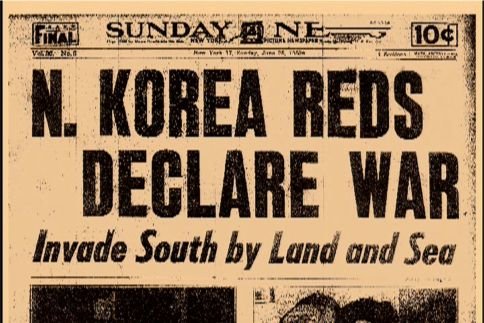
The Korean War begins when Communist North Korea invades South Korea, surprising the small So. Korean army and the small U.S. force stationed there.
It was the first “hot” war of the Cold War and the first “limited war”, meaning the objective was not to defeat the enemy but was to just achieve a limited goal of protecting So. Korea.
Hearing of the invasion, the U.S. rushed to get a United Nations resolution for military assistance. With the resolution secured, Truman dispatched U.S. military for what he called “a police action”.
This new concept of war was frustrating for the American public who was used to total victory like they had recently experienced in WWII and who never really accepted or understood the concept of “limited” warfare.
Sunday, June 23, 2013
June 24: Berlin Airlifts
On this date in History .... June 24, 1948:
The first serious crisis of the Cold War happened when the Soviets blockaded Berlin from the west, stopping the flow of supplies to the city.
Berlin had been divided up between the U.S., Britain, France and the Soviet Union. The western allies had started consolidating their occupied zones into “a single independent German state.” The USSR was not happy with the idea of a strong Germany, since they had been invaded twice by that country.
Imposing a blockade on West Berlin, cutting off
all land/rail routes was described as “…. one of the most ruthless efforts in
modern times to use mass starvation for political coercion... " For almost a year, the Allies made 450 daily
airlifts with food and supplies, preventing the over two million people from
starving.
The blockade actually backfired on the Soviets as the airlifts made the blockade moot and it provoked a real fear of war in the West. Eleven months later, Stalin lifted the blockade.
Newsreel clip:
The first serious crisis of the Cold War happened when the Soviets blockaded Berlin from the west, stopping the flow of supplies to the city.
Berlin had been divided up between the U.S., Britain, France and the Soviet Union. The western allies had started consolidating their occupied zones into “a single independent German state.” The USSR was not happy with the idea of a strong Germany, since they had been invaded twice by that country.
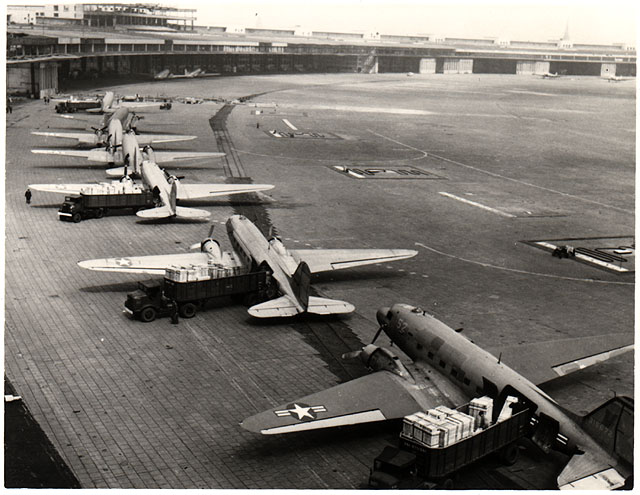 |
Seven
U.S. Air Force Douglas C-47 airplanes
unloading
cargo at Tempelhof Airport,
Berlin,
Germany during Operation Vittles
(Berlin
Airlift). Photo: U.S. Airforce
|
The blockade actually backfired on the Soviets as the airlifts made the blockade moot and it provoked a real fear of war in the West. Eleven months later, Stalin lifted the blockade.
Newsreel clip:
Sunday, June 9, 2013
June 9: Johnson and the Domino Theory
On this date in History .... June 9, 1964:
Johnson ignores a CIA report that challenges the domino theory.
The “domino theory” was a product of the Cold War and justified the U.S. involvement in helping smaller countries avoid communism. It was a belief that if one country fell to communism, then surrounding countries would “fall like dominoes”. The CIA report stated that Cambodia would be the only country to fall immediately but even if Vietnam and Laos fell to Communism, there were enough American Allies in the Pacific to dissuade N. Vietnam and China from aggression.
Johnson, who held strongly to the domino theory, chose to ignore this report, eventually committing over 500,000 troops to Vietnam to try to thwart the spread of Communism.
Johnson ignores a CIA report that challenges the domino theory.
The “domino theory” was a product of the Cold War and justified the U.S. involvement in helping smaller countries avoid communism. It was a belief that if one country fell to communism, then surrounding countries would “fall like dominoes”. The CIA report stated that Cambodia would be the only country to fall immediately but even if Vietnam and Laos fell to Communism, there were enough American Allies in the Pacific to dissuade N. Vietnam and China from aggression.
Johnson, who held strongly to the domino theory, chose to ignore this report, eventually committing over 500,000 troops to Vietnam to try to thwart the spread of Communism.
Friday, March 1, 2013
March 1: Green Feather Movement
On this date in History .... 1954:
In the Cold War era, the Indiana State Textbook Commission had recently raised arms against the Robin Hood legend appearing in schools for its communist undertones in the "rob-the-rich-give-to-the-poor" theme. The students saw the Robin Hood fuss as the epitome of McCarthyism pushed too far. They found their symbol and were ready to run with it. They would call it the "Green Feather Movement" with the five involved standing as "Robin Hood's Merry Men."
Only two days pass before the entire state is involved in the controversy. Word spreads through the Midwest, and news organizations from Louisville to Indianapolis start taking sides. One Bloomington newspaper goes so far to say that the students are acting on behalf of the adults on campus who lack "courage of their conviction."
The Green Feather movement consequently spread to the Universities of Michigan, Illinois, and to Purdue and other universities across the country. Even Harvard University announced in May 1954 that a chapter would be formed on their campus. The movement was discontinued after McCarthy’s censure in December 1954.
(Sources for this article include www.thecrimson.com and www.idsnews.com)
.
The Green Feather movement started in the campus of
Indiana University when five “Merry
Men” students covered the campus in green chicken feathers, tacking one to
every bulletin board on campus, as a protest to McCarthyism and in response to an
Indiana Textbook commissioner, Mrs. Thomas White, calling Robin Hood a
communist.
In the Cold War era, the Indiana State Textbook Commission had recently raised arms against the Robin Hood legend appearing in schools for its communist undertones in the "rob-the-rich-give-to-the-poor" theme. The students saw the Robin Hood fuss as the epitome of McCarthyism pushed too far. They found their symbol and were ready to run with it. They would call it the "Green Feather Movement" with the five involved standing as "Robin Hood's Merry Men."
Only two days pass before the entire state is involved in the controversy. Word spreads through the Midwest, and news organizations from Louisville to Indianapolis start taking sides. One Bloomington newspaper goes so far to say that the students are acting on behalf of the adults on campus who lack "courage of their conviction."
The Green Feather movement consequently spread to the Universities of Michigan, Illinois, and to Purdue and other universities across the country. Even Harvard University announced in May 1954 that a chapter would be formed on their campus. The movement was discontinued after McCarthy’s censure in December 1954.
(Sources for this article include www.thecrimson.com and www.idsnews.com)
.
Saturday, January 5, 2013
January 5: Truman's "Fair Deal"
On this date in History .... 1949:
Truman tries to piggyback FDR’s “New Deal” ideas by offering a “Fair
Deal” in his State of the
Union address, stating that the people of the U.S. had a right to expect a fair
deal from their government.
He wanted to
increase minimum wage, offer a national health care program, improve public
housing, federal aid for education, assistance to farmers and more. However, coming right at the end of World War
II, these ideas sounded too close to socialism and an anti-communist attitude
threw up barriers to Truman’s ideas.
He
did get a few changes passed, such as increasing minimum wage from 40 cents to
75 cents an hour but by 1950, the Korean and Cold Wars were detracting his
attention from domestic matters.
.
Wednesday, January 2, 2013
January 2: Folk Singers, The Weavers
On this date in History .... 1962:
The folk singing group, The Weavers, were banned from NBC and the Jack Paar Show when they refused to sign a loyalty oath disavowing the Communist Party.
The Weavers were big in the folk-singing revival era of the 1950s. It is said that without the Weavers, there would be no Bob Dylan and no Peter, Paul and Mary. Their records sold in the millions. But when it came to light they were pacifists who agreed with the pro-labor sympathies of the Communist party, their popularity dropped like hot lead.
The group was put under FBI surveillance, lost their recording contract and were called to testify at McCarthy’s House of Un-American Activities Committee.
They made a small comeback in the early 1960s but nowhere near the level they enjoyed prior. When asked by NBC to sign the oath, every member of the group refused.
http://www.youtube.com/watch?v=ZCSTqYLfP5A
The folk singing group, The Weavers, were banned from NBC and the Jack Paar Show when they refused to sign a loyalty oath disavowing the Communist Party.
The Weavers were big in the folk-singing revival era of the 1950s. It is said that without the Weavers, there would be no Bob Dylan and no Peter, Paul and Mary. Their records sold in the millions. But when it came to light they were pacifists who agreed with the pro-labor sympathies of the Communist party, their popularity dropped like hot lead.
The group was put under FBI surveillance, lost their recording contract and were called to testify at McCarthy’s House of Un-American Activities Committee.
They made a small comeback in the early 1960s but nowhere near the level they enjoyed prior. When asked by NBC to sign the oath, every member of the group refused.
http://www.youtube.com/watch?v=ZCSTqYLfP5A
Monday, December 24, 2012
December 24: Walter-McCarren Act
On this date in History .... 1952:
The Walter-McCarren Act goes into effect, changing some of the criteria
for immigrants to be
admitted to the U.S. While it did little
to change the quota system that was already in place, it still gave preference
to European immigrants, specifically England, Ireland and Germany, giving these
three countries two-thirds of the allocated slots available. But it did remove some racial barriers that
had previously
excluded Japan and China, which were assigned very small quotas.
The Act called for a more intense screening
to make sure anyone labeled a subversive was not allowed entry and those from
communist or communist-front organization were to be deported. “In defending the act, Senator McCarren
declared, "If this oasis of the world should be overrun, perverted,
contaminated, or destroyed, then the last flickering light of humanity will be
extinguished."
President Harry S. Truman took a very different view,
calling the legislation "un-American" and inhumane. When the bill was
passed in June 1952, Truman vetoed the bill. Congress overrode his veto, and
the act took effect in December.”
Sunday, December 2, 2012
December 2: Monroe Doctrine
On this date in History .... 1823:
President James Monroe, in his annual message to Congress, warned European nations that the United States “would not tolerate further colonization or puppet monarchs” and basically told them to “stay out of our backyard” and not interfere in “affairs of the Western Hemisphere.” He stated, "The American continents … are henceforth not to be considered as subjects for future colonization by any European powers."
This message, named The Monroe Doctrine, that he “buried in a routine annual message delivered to Congress,” became the watchword of U.S. policy in the western hemisphere.
It has been invoked a number of times. In 1904, Theodore Roosevelt invoked the Monroe Doctrine when a number of European countries threatened armed intervention to collect debt. Roosevelt sent U.S. Marines into the Latin countries to keep European countries out and prevent war activity near the United States. President Kennedy invoked the Doctrine during the Cuba Missile Crisis of 1962, convincing the Soviet Union to dismantle the missiles and missile sites in Cuba.
President James Monroe, in his annual message to Congress, warned European nations that the United States “would not tolerate further colonization or puppet monarchs” and basically told them to “stay out of our backyard” and not interfere in “affairs of the Western Hemisphere.” He stated, "The American continents … are henceforth not to be considered as subjects for future colonization by any European powers."
This message, named The Monroe Doctrine, that he “buried in a routine annual message delivered to Congress,” became the watchword of U.S. policy in the western hemisphere.
It has been invoked a number of times. In 1904, Theodore Roosevelt invoked the Monroe Doctrine when a number of European countries threatened armed intervention to collect debt. Roosevelt sent U.S. Marines into the Latin countries to keep European countries out and prevent war activity near the United States. President Kennedy invoked the Doctrine during the Cuba Missile Crisis of 1962, convincing the Soviet Union to dismantle the missiles and missile sites in Cuba.
Saturday, December 1, 2012
December 1: Antartica Treaty
On this date in History .... 1959:

The Antarctica Treaty is signed by the U.S., Russia and ten other
nations, banning
military activity and weapons testing on the continent, becoming the first arms
control agreement signed in the Cold War period.
The “South Pole” area, the
Earth’s only continent without a native human population (and therefore no
citizenship or government), had been a constant clash of claims against
territorial ownership and U.S. officials wanted Pres. Eisenhower to be more
assertive as they believed it to be a great space for nuclear testing.

Eisenhower, however, took the opposite
approach. He began working with the Soviets and the treaty made it military
free and allowed scientific expeditions to travel across any area claimed by
other nations without any hindrance or problems, encouraging “environmental
stewardship”.
There are now over 50
countries that have signed the treaty.
.
.
Subscribe to:
Posts (Atom)