Showing posts with label Supreme Court. Show all posts

Tuesday, June 16, 2015

May 4: Ida B. Wells

On this date in History .... May 4, 1884:

Ida B. Wells, a schoolteacher, was sitting in a woman’s railroad car, reading, when the conductor ordered her to move to the “Jim Crow” car. She refused, saying that was a smoking car and she was in the ladies car.  When the conductor grabbed her, she “sunk her teeth” into his arm.  

The 1875 Civil Rights Act had banned discrimination based on race on transportation but in 1883, the Supreme Court declared this act unconstitutional.  The ruling said Congress did not have the power to void discrimination acts by individuals as it did on state action or laws  Private acts of racial discrimination were simply private wrongs that the national government was powerless to correct”.

When she sued the railroad for her treatment, her attorney was paid off by the railroad, so she hired a white attorney and won a $500 settlement.  The judge says she was indeed a lady.  She was a schoolteacher and was “dressed accordingly.”  Her victory was overturned by the Tennessee Supreme Court.  Ms. Wells went on to be a civil rights activist by being a journalist. 
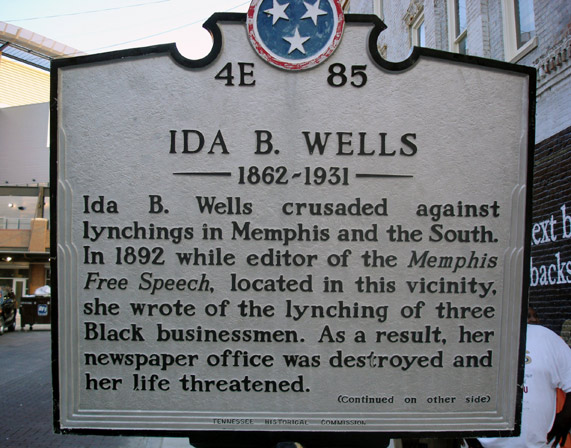
As a journalist, she became aware that the new black middle class was at risk when three of her friends were lynched.  Before this, she had thought such lynchings, while deplorable, were targeted at those in the lower class who may have been involved in activities that merited a kind of punishment.  Her eyes were then opened to see that lynchings were a way to “get rid of negroes who acquired wealth and property and thus keep the race terrorized…..”


Sources include: 

Wednesday, April 29, 2015

April 28: Muhammad Ali

On this date in History .... April 28, 1967:  


Muhammad Ali refuses to be inducted in the Army during the war with Vietnam, claiming religious reasons.  He said, “I ain’t got no quarrel with those Vietcong. They never called me n*****.”  

He was prosecuted for draft evasion and sentenced to five years and $10,000 but remained out of jail during the appeal. He was stripped of his title and banned from boxing for three years. 

On June 28, 1971, the Supreme Court overturned his draft evasion conviction with an 8-0 vote, saying the government had failed to properly specify why his application for conscientious objector status had been denied.

.

Thursday, April 9, 2015

April 9: "Journey of Reconciliation"

On this date in History ... April 9, 1947:  


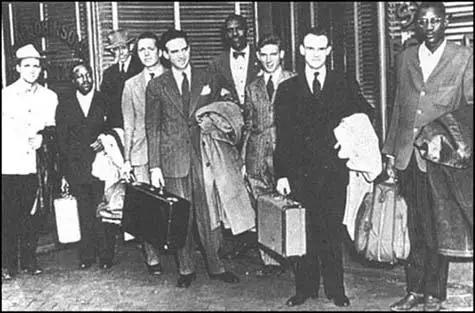
Members of the Journey of Reconciliation in 1947. Left to right: Worth
Randle, Wallace Nelson, Ernest Bromley, 
James Peck
, Igal Roodenko,
Bayard Rustin
, Joseph Felmet, George Houser and Andrew Johnson.

Sixteen men (eight white and eight black) begin a 2-week “Journey of Reconciliation” to challenge segregation laws on interstate buses in the South.  

Inspired by the Supreme Court case Morgan v. Virginia (that story to be posted on June 3), which declared segregation on interstate buses to be unconstitutional. Many southern states were blatantly ignoring this ruling. 

The riders suffered several arrests but in North Carolina, the judge showed his particular disdain for the white men taking part in the rides:  "It's about time you Jews from New York learned that you can't come down here bringing your niggers with you to upset the customs of the South. Just to teach you a lesson, I gave your black boys thirty days [on a chain gang], and I give you ninety."

The Journey of Reconciliation achieved a great deal of publicity and was the start of a long campaign of direct action by the Congress of Racial Equality. In February 1948 the Council Against Intolerance in America gave George Houser and Bayard Rustin the Thomas Jefferson Award for the Advancement of Democracy for their attempts to bring an end to segregation in interstate travel.

Sources include: http://spartacus-educational.com/USAjor.htm

Tuesday, April 7, 2015

April 7: Crossing Burning is Free Speech

On this date in History ... April 7, 2003:  

The Supreme Court decided the case of Virginia v. Black (5-4) that cross burning was protected under the First Amendment’s Freedom of Speech, but, according to the opinion written by Sandra Day O’Conner, “..a state, consistent with the First Amendment, may ban cross burning carried out with the attempt to intimidate.” 

In so doing, the Court created a new area of constitutionally unprotected speech for “true threats.”  

Clarence Thomas wrote the dissent, stating, “This statute prohibits only conduct, not expression. And, just as one cannot burn down someone’s house to make a political point and then seek refuge in the First Amendment, those who hate cannot terrorize and intimidate to make their point.”


.

Sunday, March 9, 2014

March 9: Indiana passes sterilization laws

On this date in History ... March 9, 1907:  

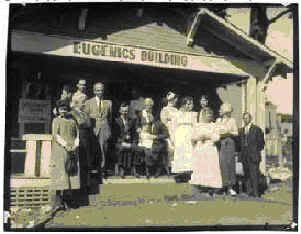
Indiana becomes the first state to pass sterilization legislation for the purpose of eugenics (the practice of “improving the genetic population”). The law targeted “confirmed criminals, idiots, imbeciles, and rapists”. 

When this law was struck down in 1921 by the Indiana State Supreme Court, a second law was passed in 1927 which limited the procedure to “Insane, feeble minded or epileptic”, indicating a move from sterilizing the mentally ill and criminals to only the mentally ill. 

The laws were designed to target those in state institutions, not the general public. They were repealed in 1974. Between 1907 and 1974, about 2500 of these procedures were carried out.

(See also May 2, 2013 and May 9, 2013 postings for additional eugenics history in Indiana.)


March 3: Women and the Supreme Court

On this date in History .... March 3, 1879:

Belva Lockwood became the first woman sworn in as a member of the U.S. Supreme Court Bar, and was the first woman to argue a case before the Supreme Court. 

In 1884, Lockwood became the second woman (after Victoria Woodhull) to run for President of the United States. She was the first to appear on the election ballot and to engage in a full-fledged campaign as the candidate for the National Equal Rights Party. 

In 1914, when she was 84 yrs old and asked whether a woman would one day be president she replied, “If a woman demonstrates that she is fitted to be president she will someday occupy the White House. It will be entirely on her own merits, however. No movement can place her there simply because she is a woman. It will come if she proves herself mentally fit for the position.”

MARCH:  WOMEN'S HISTORY MONTH

Friday, August 2, 2013

August 2: Myra Bradwell, Woman Lawyer

On this date in History .... August 2, 1869:


photo courtesy of
Columbia law library.edu
Myra Bradwell passed the Illinois Bar Exam at the age of 38, becoming one of the first women lawyers in the country and the first woman lawyer in Illinois. (Arabella Mansfield is credited with being the first woman to pass the bar (in Iowa) in June 1869.) However, the Illinois Supreme Court denied Bradwell admission to the bar, not because she was a woman …. but because she was a married woman.  They were afraid that since a lawyer may be held responsible for their actions, she might be arrested and “therefore she would not be available to her husband.”

 "The natural and proper timidity and delicacy which belongs to the female sex evidently unfits it for many occupations of civil life....The paramount destiny and mission of women are to fulfill the noble and benign office of wife and mother. This is the law of the Creator." [83 U.S. 130 at 141].   

Her appeal to the Illinois Supreme Court was denied but this time it WAS because she was a woman, with one of the four reasons being that allowing her to practice law would “open the floodgates” and the court feared civil offices would be filled with women.

Bradwell appealed the decision to the Supreme Court who also denied her access to practice law. Illinois eventually passed laws to permit women to practice law and in 1890, she was granted a license to practice law. Her license was granted munc pro tunc (“now for then”) and dated 1869, making her officially the first licensed woman lawyer in Illinois.

Bradwell was the lawyer for Mary Todd Lincoln’s insanity trial in 1875 when Lincoln was declared sane and released from the sanitarium.  (SEE ALSO MY BLOG OF JUNE 19 – MARY TODD LINCOLN) 

In 1868, Bradwell founded The Chicago Legal News, a regional legal-news newspaper that was the highest circulated legal newspaper for over two decades. She became very involved in married women’s property rights, drafting a law in 1869 to protect the earnings of married women and to protect the interest of widows in their husbands’ estates.

Her daughter graduated law school in 1882 and continued to run the newspaper until 1925.

Saturday, July 13, 2013

July 14: Richard Speck

On this date in History .... July 14, 1966:

Photo from www.biography.com 
Richard Speck murders 8 student nurses in Chicago.  

He broke into their dorm, held them for hours, then one by one took them out of the room, and stabbed or strangled them to death.  He raped the last student before killing her.  He was unaware of a 9th student, hiding under the bed, who stayed hidden until the next morning, then climbed out onto a ledge screaming “My friends are dead!” 

After only 49 minutes of deliberation, the jury found him guilty and he was sentenced to the electric chair.  However, in 1972 the death penalty was lifted because of the Supreme Court decision in Furman v. Georgia (see my June 29 history posting), and sentence was converted to life.  

Speck died of a heart attack one day prior to his 50th birthday.


.

Saturday, June 29, 2013

June 29: Supreme Court rules on death penalty

On this date in History ..... June 29, 1972:

For the first time, the Supreme Court rules against the death penalty, in Furman v. Georgia, calling it “cruel and unusual punishment” as it was currently used, saying that states primarily used it in “arbitrary and capricious ways especially in regard to race.” However, the Court also suggested legislation that would make it constitutional again, such as guidelines for juries that were standardized as they applied to sentencing. 

As a result of this ruling over 600 prisoners had their death sentences lifted, including Charles Manson, and Richard Speck  (murdered 8 student nurses in Chicago 1966).  

Four years later, the Court acknowledged that progress in this regard had been made and reinstated the use of the death penalty. Gary Gilmore was the first to die under the new ruling, famous for his last words of “Let’s do it.”


June 28: Supreme Court rules on Muhammad Ali

On this date in History ... June 28, 1971:

The Supreme Court unanimously overturned the lower courts in “Clay vs. the United States” in boxer Muhammad Ali’s (Cassius Clay) refusal to be drafted.  Clay had refused, based on his conversion to Islam, to go to Vietnam and shoot people "who never called me nigga....."

Ali would go on to become the first and only 3-time lineal World Heavyweight Champion. He won an Olympic Gold Medal in 1960 (his amateur records was 100 wins with 5 losses). Legend has it that he threw the medal in the Ohio River after being refused service in a whites-only restaurant. He was presented with a replacement medal at the 1996 Olympics, where he lit the torch to start the games.  

In 1993, the Associated Press reported that Ali was tied with Babe Ruth as the most recognized athlete, out of over 800 dead or alive athletes, in America. The study found that over 97% of Americans over 12 years of age identified both Ali and Ruth.


Thursday, June 20, 2013

June 21: Texas v. Johnson / Flag Burning

On this date in History .... June 21, 1989:

The Supreme Court decides Texas v. Johnson that flag burning was free speech and protected under the first amendment.  Richmond, Indiana native Gregory Lee Johnson, a member of the Revolutionary Communist Youth Brigade, was part of a demonstration at the 1984 Republican Convention in Dallas. When he poured kerosene on the flag and set it ablaze, he was charged with a Texas law of prohibits vandalizing respected objects (desecration of a venerated object).

One witness, Daniel E. Walker, a West Point graduate, received international attention when he collected the burned remains of the flag and buried them according to military protocol in his backyard. Following the incident, Walker received the Army’s highest civilian award and a letter of commendation from U.S. President Ronald W. Reagan.  Walker died in 2009 at the age of 81.

An eyewitness to the event tells this story:
"Just a few feet away from me an American flag  had been set on fire and was being held high by a young man to a combination of boos and cheers of approval. He was tackled to the ground almost immediately and an older guy who looked really out of place with the rest of the crowd took the flag away from him and began stomping on it in an attempt to put out the flames and then carried it off."        

Attorney William Kunstler and Greg Johnson
Johnson appealed his conviction one year in prison and $2000 fine to the Supreme Court. In a controversial 5-4 decision, the Court found his actions protected as free speech. The decision invalidated laws in 48 of the 50 states. Congress has tried to pass a law prohibiting flag burning a number of times but the bill fails to pass the Senate each time. 

Johnson spent his entire life involved in protests and demonstrations, eventually becoming the national spokesman for the Communist Youth Brigade. In 2011, he was arrested in California for protesting in support of a hunger strike by the Pelican State Prison inmates.  


Wednesday, June 12, 2013

June 13: Thurgood Marshall

On this date in History .... June 13, 1967:

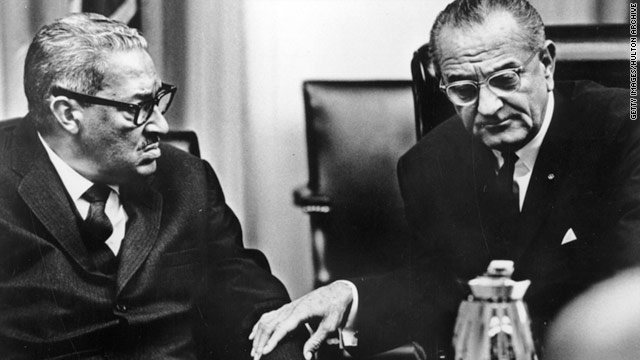
Lyndon Johnson nominated Thurgood Marshall for the U.S. Supreme Court.  

Marshall was confirmed by Congress 69-11 and sworn in on August 30, making him the first African-American to sit on the Supreme Court. 

The great-grandson of slaves, he became an attorney and argued cases before the Supreme Court, winning 29 of them, including the ground breaking Brown v. Board of Education in 1954. 

He served 24 years on the Court.

.

June 12: Interracial Marriage Now Legal

On this date in History ..... June 12, 1967:

The Supreme Court overturned the conviction of Loving v. Virginia making it illegal to ban interracial marriage. 

In addition to being guilty of an interracial marriage, Mildred and Richard Loving were also guilty of violation of Virginia law of interracial couples marrying in another state (Wash DC) and moving back to Virginia. 

Law enforcement stormed into their bedroom, shined lights in their eyes and hauled them off to jail.  They were told they could avoid the one year in prison if they left the state and never returned.  The couple decided to fight it and took it all the way to the Supreme Court.

Nine years later, the Supreme Court concluded that anti-miscegenation laws were racist and had been enacted to perpetuate white supremacy: “….The fact that Virginia prohibits only interracial marriages involving WHITE persons demonstrates that the racial classifications must stand on their own justification, as measures designed to maintain White Supremacy.” 

Despite this Supreme Court ruling, such laws remained on the books, although unenforceable, in several states until 2000, when Alabama became the last state to repeal its law against mixed-race marriage.


Monday, June 3, 2013

June 3: Corning Glass Works vs. Brennan

On this date in History ... June 3, 1974:

The Supreme Court rules in Corning Glass Works vs. Brennan

Corning’s inspectors during the day shift were women but the company wanted to start a night shift inspector position. At the time, NY and PA law prohibited women from working nights. Since the inspector position had traditionally been held by women, men viewed it as “women’s work” and refused to take the night job. Corning argued that ‘market forces’ required them to pay men more to get them to take what they viewed as inferior (women’s) work. 

Corning tried to defend its pay policy by claiming it was a shift differential pay.  But they still only hired men for the night shift, denying women the opportunity for the higher pay.

The Court rejected the argument, recognizing that the company was still paying men and women different wages for the same work, illegal under the Equal Pay Act of 1963, and that just because men wouldn’t work for “women’s pay”, didn’t mean it was ok to pay men more for the same job.

Sources for this article include The U.S. Supreme Court Center, i.e. supremejustia.com 

.

Wednesday, May 22, 2013

May 22: Annette Abbott Adams

On this date in History ... May 22, 1920:


Annette Abbott Adams becomes the first woman appointed to the position of Ass’t United States Attorney General. 

She had previously served at the first female United States Attorney, in a temporary position to replace Mr. Preston who had been promoted to U.S. Attorney General.

She served as Ass’t Attorney Gen’l until 1921, resigning when Pres. Hoover took office. In 1942, she became the first woman to serve on the Calif Court of Appeals (and as a presiding justice).

In 1950, she was given a special temporary appointment to the Calif Supreme Court, becoming the 1st woman to serve on that court.

.

Monday, May 20, 2013

May 17: Brown vs. Board of Education

On this date in History .... May 17, 1954:


U.S. Supreme Court hands down a unanimous decision that racial segregation in schools is unconstitutional in Brown vs. Board of Education. 

The case stemmed from elementary student Linda Brown whose black school was miles further away from her home that the superior white school in her neighborhood. The NAACP took up Ms. Brown’s case with lawyer Thurgood Marshall (future Supreme Court Justice) leading the case. This ruling overturned the 1896 Plessy vs. Ferguson which established the “separate but equal” accommodation in railroad cars and was used to justify segregation in all public facilities.

Sunday, April 28, 2013

April 28: Muhammad Ali Refuses to be Drafted

On this date in History ..... 1967:


Muhammad Ali refuses to be inducted in the Army during the war with Vietnam, claiming religious reasons.  He said, “I ain’t got no quarrel with those Vietcong. They never called me n*****.”  

He was prosecuted for draft evasion and sentenced to five years and $10,000 but remained out of jail during the appeal. He was stripped of his title and banned from boxing for three years. 

On June 28, 1971, the Supreme Court overturned his draft evasion conviction with an 8-0 vote, saying the government had failed to properly specify why his application for conscientious objector status had been denied.  


Monday, February 18, 2013

February 18: California Death Penalty

On this date in History ..... 1972:

The California Supreme Court rules the death penalty to be cruel and unusual punishment and in violation of the state constitution. The ruling takes 107 inmates off of death row, including Charles Manson and Sirhan Sirhan (who killed Robert Kennedy).
 
Later that same year (1972), Californians passed Proposition 17 which reintroduced the death penalty and amended the California Constitution.  No executions were carried out in California until 1992 because of the Supreme Court decision in Furman v. Georgia which temporarily suspended capital punishment in the U.S.
 
The case stemmed from People of California v. Robert Page Anderson who murdered three people during a robbery.  His sentence was commuted and in 1976, he was paroled and moved to Seattle.

.

Sunday, February 10, 2013

February 10: Ronald Brown

On this date in History ... 1989:

Ronald Brown is elected head of the Democratic National Committee.  
 
Brown, a former Supreme Court lawyer, was the first African-American to hold the top position in a major political party in the U.S.  He was also the first African-American Secretary of Commerce, appointed by Bill Clinton, who Brown helped to elect as head of the DNC. In college, Brown was the first African-American member of Sigma Phi Epsilon fraternity.  
 
Brown died on April 3, 1996 when the plane he and 32 other Americans were on crashed into a mountain in Croatia.
 
.

Tuesday, February 5, 2013

February 5: FDR's Announces Court Packing Plan

On this date in History .... 1937:

Franklin Roosevelt announced plans to expand the Supreme Court to up to 15 judges, his argument being to make it “more efficient.”  FDR had become irritated with the Court as they had struck down several of his New Deal bills. FDR plan was to pack the Supreme Court with more liberal judges who would vote with his New Deal ideas.  Before he could put the plan in place, two of the judges switched over to “the liberal side”, making FDR’s reorganization plan unnecessary.  FDR had his first chance to appoint a new justice soon after and by 1942, all but two of the judges were FDR appointees anyway.

Businessmen who found themselves heavily taxed and regulated by FDR’s new programs, pushed back through the courts.  In one of them, the Supreme Court ruled against FDR’s Agricultural Adjustment Act, stating in a 6-3 split that the tax was unconstitutional and that only the states had the power to regulate agriculture.

FDR didn’t want the states to try to piecemeal changes. He believed that only “sweeping federal reforms” could fix the problems of the Depression.  He claimed the court was overwhelmed with cases as his reasoning for adding more judges …. judges that HE would appoint to make sure his programs were passed without problem.

It is historical irony that FDR almost achieved his plan when five justices retired and two died, giving FDR the opportunity to appoint seven of the nine seated justices anyway


.