 |
| Gov. Oliver Morton Photo courtesy of www.nps.gov |
Morton was the first Indiana-born governor and served as the “war-time governor” of Indiana for six years (Jan. 16, 1861–Jan. 23, 1867) and strongly supported the Union during the Civil War. He began his political career as a Democrat but was thrown out of the party because of his anti-slavery stance. As governor, he raised men and money for the Union army, and successfully suppressed Indiana's Confederate sympathizers.
“Morton immediately dissolved the General Assembly and announced his intent to administer the state without its representatives. As the state approached bankruptcy, Morton successfully solicited the donation and loan of millions of dollars in private money that were then used to fund the government. He continued to harass and suppress the activities of his political opponents whom he occasionally accused of treason.
It is thought that because of his scrupulous honesty during this period of one-man rule he was able to escape post-war retribution for his actions. He was reelected governor in 1864 and served until his appointment to the U.S. Senate in 1867. “
quote source: http://www.nps.gov/resources/person.htm?id=103
During his early tenure
as governor, Morton believed that war was inevitable and began to prepare the
state for it. He appointed men to cabinet positions who were well known to be
against any compromise with the southern states. He established a state arsenal
and employed seven hundred men to produce ammunition and weapons without
legislative permission and made many other preparations for the war to come.
When open war finally
broke out on April 12, 1861, he telegraphed President Abraham Lincoln three
days later to announce that he already had 10,000 soldiers underarms ready to
suppress the rebellion.
“In 1865, when Morton had a paralytic stroke
and went to Europe for treatment, the President entrusted him with a
confidential mission to Napoleon III concerning
the withdrawal of the French troops from Mexico.” (quote source: http://www.nndb.com/people/209/000050059/
In 1867, he was elected
to the U.S. Senate where he served until his death in 1877.
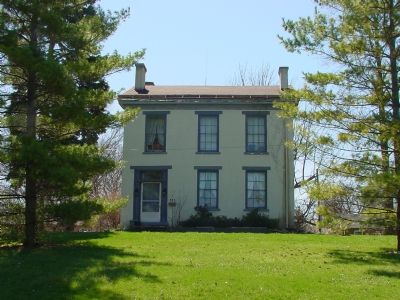 |
| Oliver P. Morton Home, Centerville Indiana. For more photos, explore this link: http://www.hmdb.org/Marker.asp?Marker=264 |


