Showing posts with label Lincoln. Show all posts

Wednesday, March 3, 2021

ELIZABETH KECKLEY - Seamstress in the White House

 On this date in history - March 4, 1861 - 


Elizabeth Keckley meets Mary Todd Lincoln on the day of Lincoln’s first 
Inauguration and ended up becoming Mrs. Lincoln’s dressmaker and companion.  Keckley was born a slave, owned by her father. She became a nursemaid to her master’s baby when she was 4 or 5. Her mother, a domestic servant and seamstress, was well liked by the family and was allowed to be taught to read and write. She taught these skills to her daughter Elizabeth.  

The white family had multiple financial problems and Elizabeth’s sewing skills were eventually used to make money for the family and their 17 children.  She offered to give all of her money to her owner in exchange for not hiring out Elizabeth’s aged mother for extra money as they were on the verge of bankruptcy.  Soon other white women were coming to her for their dresses. 

She found supporters who helped her buy her and her only son’s freedom, then moved to Washington DC. where she found it hard to set up a business unless she could find a white person to vouch that she was really free.  A client helped put her in touch with a few influential people, including Varna Davis, the wife of soon-to-be Confederate President Jefferson Davis.  Davis encouraged Elizabeth to come with her to the South “….as a war will soon be upon us.”  Elizabeth declined.  

The Lincolns soon arrived in DC to get ready for Lincoln’s inauguration.  A DC woman needed a dress made for a social meeting she had with the Lincolns,  but Elizabeth turned it down due to the late notice.  The customer told her “I have often heard you say that you would like to work for the ladies of the White House. Well, I have it in my power to obtain you this privilege. I know Mrs. Lincoln well, and you shall make a dress for her provided you finish mine in time to wear at dinner on Sunday.” 

The dress was made and Elizabeth was introduced to Mary Todd Lincoln.  They developed a strong business and personal relationship.  Elizabeth’s only son, George, a Union soldier, was killed in battle about six months before Willie Lincoln died.  Two mothers mourning the death of their sons bonded Elizabeth and Mary Lincoln even closer.  When Lincoln was shot, Mary Lincoln cried out for Elizabeth to be brought to her side for comfort. 

In 1868, Elizabeth wrote a book about her years in the White House, Behind the Scenes or Thirty Years a Slave, Four Years in the White House, believing it would  help “redeem her own character as well as Mrs. Lincoln’s.”  There had been great controversy about Mrs. Lincoln’s decision to try to sell some of her clothes to raise money and Elizabeth had helped with this project.

“By writing down the story of her enslavement, her intimate conversations with Washington’s elite women, and her relationship with Mary Lincoln, Keckly violated social norms of privacy, race, class, and gender.  Although other formerly enslaved people like Frederick Douglass wrote generally well received memoirs during the same time period…..” , the book by Elizabeth, a black woman, seemed to enrage the public, with some pointing this as a reason black women should not be educated.

Mrs. Lincoln felt “betrayed by the intimate details” and never spoke to Elizabeth again. Elizabeth’s customers began disappearing and she began training other seamstresses. “In 1892, she accepted a position as the head of Wilberforce University’s Dept of Sewing and Domestic Science Arts.”  She died May 26, 1907, at the age of 89, a t the National Home for Destitute Colored Women and Children.

Tuesday, April 21, 2015

April 21: Lincoln's Funeral Train

On this date in History ..... April 21, 1865:

Marker on the lawn of the Indiana State House, Indianapolis IN
Lincoln’s funeral train leaves Washington in what became the nation’s first national funeral. The train also carried the exhumed coffin of his 11 year old son Willie (who had died in 1862) so he could be buried next to his father. 

The train traveled through seven states and 180 cities on its way to the burial site in Illinois, where Lincoln would be buried on May 4th.  It stopped in small & large cities with millions lining the railway in the rain, wind & during the night to see the train. It was reported that people waited in line as long as five hours to walk past Lincoln's coffin.

When the train went through (my hometown of) Richmond, Indiana, Governor Oliver P. Morton boarded the train. At least 50,000 walked through the Indianapolis State House rotunda to view the open casket that sat on display.

The train car that carried Lincoln's body was destroyed in a fire in 1911.

Tuesday, August 6, 2013

August 6: Lincolns signs Confiscation Act

On this date in History .... August 6, 1861:  

Lincoln signs the Confiscation Act, the first legislative act toward emancipation of slaves. 

The Act recognized that slaves doing the work on a plantation were freeing up the white Southerners to have plenty of time to fight in the war.  Slaves were also used for menial tasks in the war, also enabling the war effort.  

The Act stripped slave owners of any claim to slaves and made them “confiscated property” of the United States.  The Act stated that any slave who worked for “disloyal masters in some form of work against the United States” were free. 

The law was not enforced uniformly with some Union officers returning slaves back over Confederate lines.  Union (Democrat) Gen’l McCook was so “obliging” in returning slaves to their owners that he was praised in Confederate newspapers.

August 5: Lincoln signs Tax Bill

On this date in History .... August 5, 1861:  

Lincoln signs the Revenue Act, imposing a 3% tax on incomes over $800 (comparable to $30,000 +/- in 2010 dollars) to pay for the Civil War.  He asked multiple Cabinet members about his constitutional authority to impose such a tax.  Lincoln’s tax law was repealed in 1871 but was replaced in 1909 by the 16th amendment (ratified in 1913) which set in place the income tax system we all “enjoy” today.


Sunday, August 4, 2013

August 4: Gov. Oliver P. Morton

On this date in History .... August 4, 1823:  


Gov. Oliver Morton
Photo courtesy of
www.nps.gov
Oliver Perry Throck Morton is born in Salisbury (Wayne County) Indiana. (Salisbury no longer exists but was located between Richmond and Centerville on the east side of the state.)  The family name of “Throckmorton” was shortened to “Morton” but the males in the family carried the “Throck” name as a middle name.  

Morton was the first Indiana-born governor and served as the “war-time governor” of Indiana for six years (Jan. 16, 1861–Jan. 23, 1867) and strongly supported the Union during the Civil War. He began his political career as a Democrat but was thrown out of the party because of his anti-slavery stance.  As governor, he raised men and money for the Union army, and successfully suppressed Indiana's Confederate sympathizers.

“Morton immediately dissolved the General Assembly and announced his intent to administer the state without its representatives. As the state approached bankruptcy, Morton successfully solicited the donation and loan of millions of dollars in private money that were then used to fund the government. He continued to harass and suppress the activities of his political opponents whom he occasionally accused of treason. 

It is thought that because of his scrupulous honesty during this period of one-man rule he was able to escape post-war retribution for his actions. He was reelected governor in 1864 and served until his appointment to the U.S. Senate in 1867. “  

During his early tenure as governor, Morton believed that war was inevitable and began to prepare the state for it. He appointed men to cabinet positions who were well known to be against any compromise with the southern states. He established a state arsenal and employed seven hundred men to produce ammunition and weapons without legislative permission and made many other preparations for the war to come.

When open war finally broke out on April 12, 1861, he telegraphed President Abraham Lincoln three days later to announce that he already had 10,000 soldiers underarms ready to suppress the rebellion.

“In 1865, when Morton had a paralytic stroke and went to Europe for treatment, the President entrusted him with a confidential mission to Napoleon III concerning the withdrawal of the French troops from Mexico.”  (quote source: http://www.nndb.com/people/209/000050059/


In 1867, he was elected to the U.S. Senate where he served until his death in 1877.

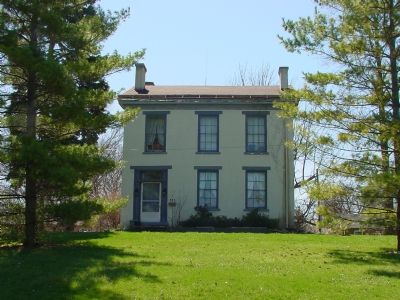
Oliver P. Morton Home, Centerville Indiana.
For more photos, explore this link:
http://www.hmdb.org/Marker.asp?Marker=264 

Monday, July 1, 2013

July 1: "Death Tax" passed

On this date in History .... July 1, 1862:

Congress passes what develops into an Estate Tax: A duty/tax on certain "legacies or distributive shares arising from personal property" passing, either by will or intestacy, from deceased persons.” 

This was part of the tax structure implemented by Lincoln to cover the cost of the Civil War. (Ironic observation: a tax passed that will tax the transfer of assets when a person dies …. during the war that killed more Americans than any other war.) 

The modern estate tax was passed Sept 8, 1916. 

The term “death tax” was coined in the 1940s, which is a term that relates back to the original use of the term “death duties”. A political pollster wrote that “the term ‘death tax’ kindled voter resentment in a way that 'inheritance tax' and 'estate tax' do not".  

According to the New York Times (in 2006), “Estate tax lawyers are the most productive tax law enforcement personnel at the IRS… For each hour they work, they find an average of $2,200 of taxes that people owe the government.”

.

Wednesday, June 19, 2013

June 19: Mary Todd Lincoln declared sane

On this date in History .... June 19, 1875:

Mary Todd Lincoln was declared sane. 

She had been committed to the Bellevue Insane Asylum in 1875 and made two suicide attempts the day that verdict was made.  Myra Bradwell, one of the country's first women lawyers, believed Lincoln to be sane and filed an appeal on her behalf citing that Lincoln was being held against her will.  

After the courts found in favor of Mrs. Lincoln, she moved to France for four years before returning to the U.S. to live with her sister. She died two years later.

.

Monday, March 4, 2013

March 4: Robert Smalls

On this date in History .... 1875:

Robert Smalls joins the House of Representatives from South Carolina’s 5th District. A former slave, he was the last Republican to represent the district until 2010.
 
As a politician, Smalls authored state legislation providing for South Carolina to have the first free and compulsory public school system in the United States, and founded the Republican Party of South Carolina. He is notable as the last Republican to represent South Carolina's 5th congressional district until 2010.”

The first ten years of his life were relatively easy.  It is rumored that his master, Henry McKee, was his father. Smalls was taken around town by McKee and he was permitted to play with other children, black and white.  This bothered his slave-mother who made sure he saw and understood the horrors of the life of slavery.  She made him sleep on the earthen floor, not on a cot. She made him work in the fields, pick cotton, and wear tattered clothes like other slaves. She even took him to watch the activities at the whipping post so he could truly understand what it was like to be a slave.

As a 12-year old slave, his master sent him to Charleston to be hired out on ships where he gained a high level of knowledge about ships and the Charleston harbor.  While on the USS Planter, he planned and executed a daring escape, disguising himself as the ship’s captain and even stopping to pick up his family. He used the correct Confederate signals to get past the Confederate ships.  He then raised a white sheet as a flag and headed straight for the Union fleet.  He turned the ship and its contents, which included a copy of the Confederate code book and locations of mines in the harbor, over to the Union Army.

Congress passed a bill, signed by Lincoln, enabling Smalls and his other “Negro crew members” to receive the prize money for turning over the Confederate ship (about $1500).  He met Lincoln himself just a couple of weeks later.  Because of the debate on allowing African Americans to join the military, Smalls served in the Union Army as a civilian.

"In December 1863, Smalls became the first black captain of a vessel in the service of the United States. On December 1, 1863, the Planter had been caught in a crossfire between Union and Confederate forces. The ship's commander, Captain Nickerson, decided to surrender. Smalls refused, fearing that the black crewmen would not be treated as prisoners of war and might be summarily killed. Taking command, Smalls piloted the ship out of range of the Confederate guns. For his bravery, Smalls was named to replace Nickerson as the Planter's captain. Smalls returned with the Planter to Charleston harbor in April 1865 for the ceremonial raising of the American flag upon Ft. Sumter."  (Quote Source: Wikipedia)


After the war, he returned to the South and purchased his former master’s house.  His mother lived with him for the rest of her life and he even permitted his previous master’s wife to live with them in the house prior to  her death.  The home as been designated as a National Historic Landmark.


Tuesday, February 12, 2013

February 12: Dr. Henry Garnet

On this date in History .... 1865:

Rev. Dr. Henry Highland Garnet, former slave and pastor of the 15th Street Presbyterian Church, becomes the first African-American to deliver a sermon to the U.S. House of Representatives, ”commemorating the victory of the Union armies and the deliverance of the country from slavery.”
 
Pres. Lincoln had arranged for this special sermon, with full consent of his Cabinet,  on the President’s 56th birthday. 
 
In 1881, Garnet was appointed U.S. minister to Liberia but died only 2 months after his appointment.

Monday, December 17, 2012

December 17: Grant bans Jews from territory

On this date in History ..... 1862:

General Grant expels Jews from territory for war profiteering on cotton. 

As Grant worked his way through the South, speculators followed him through the captured territories, buying up cotton at rock bottom prices and selling it for a high profit in the North where cotton was badly needed. When Grant’s father came down for a visit and brought some Ohio friends with him, Grant realized the friends, who were Jewish, were speculators and was livid at the profiteering.  He issued his famous Order #11, banning all Jews from the territory. 

The uproar was swift and loud.  Lincoln ordered Grant to rescind the order immediately. 


.

Thursday, December 6, 2012

December 6: 13th Amendment

On this date in History.... 1865:

The 13th Amendment is ratified to the U.S. Constitution, officially ending slavery in the United States. It came eight months after the war and is tagged as the greatest change to come out of the Civil War. The Senate passed the amendment in April 1864. 
 
Republicans wanted to ban slavery entirely but Democrats wanted to restore the states’ rights to decide, keeping alive the possibility that slavery could still exist.  A Republican victory in the upcoming election would almost guarantee the passage.  Lincoln’s overwhelming victory pushed the amendment forward and the House passed it in January 1865.  It was sent to the states for ratification and when Georgia ratified it on Dec 6, slavery was officially abolished.
 
.

Wednesday, November 7, 2012

November 8: the Trent Affair

On this date in History .... 1861:


The Trent Affair came close to causing war between the United States and Great Britain when two Confederate messengers were removed from the British steamer ‘Trent’.  The two men were on their way to Europe to gain recognition as a separate country from Britain and France. The British captain claimed the two were under the protection of the British flag, but the neutrality of Britain was ignored as the two men were “captured” and removed anyway. 

Britain was enraged at this ‘breach of international law’ and came close to declaring war on the Northern States. After several weeks of negotiation and conversation, the two Confederates were released and they continued their mission to Britain, but failed to establish the diplomatic relationship desired, which would have given credibility on the international front to the Confederacy.
***************************

The Union’s goal was to prevent any kind of diplomatic recognition from any country toward the Confederacy, and continued to proclaim the war was strictly an “internal insurrection” and the Confederacy should not be granted any status or rights under international law.  It was also implied any such recognition would be considered an “unfriendly act” towards the United States.  Britain, already busy watching Napoleon III in France and Otto von Bismarck in Prussia, had no time for a third front of potential war.

In the previous May 1861, Queen Victoria had issued a statement of neutrality recognizing the South as a belligerent state (i.e. a country that wages war). This status of neutrality allowed Confederate ships in British ports to be treated the same as Union ships: they could obtain fuel, repairs and supplies but could not obtain military equipment.

The Union was livid over the designation as they felt it was just one step away from recognizing the South with international diplomacy rights.  Word was sent that formal recognition would make Britain an enemy of the U.S.  When it was learned two ambassadors would be on board the Trent, the two men were removed, their trip delayed by weeks, with an end result of diplomacy not being recognized.  "The United States had lost face, but the Confederacy had lost her best opportunity for European intervention. During the balance of the war no other issue brought Great Britain so close to war ."
(quote source:  http://clevelandcivilwarroundtable.com/articles/naval/trent_affair.htm )


Sunday, November 4, 2012

November 4: Lincoln Weds

On this date in History .... 1842:

Abraham Lincoln marries Mary Anne Todd.

They met at a cotillion and began  seeing each other socially the very next day. Despite their 10-yr age difference and her family’s objections, she accepted the proposal of the tall, lanky and living-in-poverty lawyer.  However, Lincoln called off the engagement in early 1841, but they got back together in the fall of 1842. 

Not wasting any time with a long engagement, they made plans to immediately marry. They both wanted a small wedding and planned to wed on Nov 3. They had to push it out a day because Mary’s guardian insisted she be married in their home but a sewing society meeting was being held in the home on the 3rd. About 30 people attended.  Mary wore a simple white muslin dress but no veil or flowers. They were married for 22 years.

The room where Abraham Lincoln and Mary Todd were married.  Photo courtesy of http://rogerjnorton.com/