Showing posts with label Truman. Show all posts

Friday, July 26, 2013

July 26: Truman sets of NSA

On this date in History .... July 26, 1947:

Truman signs the National Security Act which set up much of the framework for policy making for the next 40 years of the Cold War. 

The Act established a unified Dept of Defense. It established the Nat’l Security Council which would service as a clearinghouse of information that gave brief but detailed reports to the President. It established the CIA, which replaced the CIG, the Central Intelligence Group. 

The CIA, however, became much more. It was a separate agency that would not only gather information but carry out covert operations in foreign countries. 

Monday, June 24, 2013

June 25: Korean War Begins


On this date in History ... June 25, 1950:  


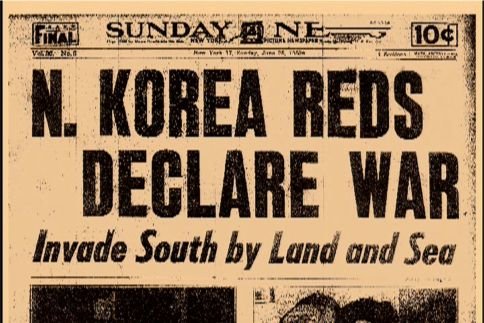
The Korean War begins when Communist North Korea invades South Korea, surprising the small So. Korean army and the small U.S. force stationed there.  

It was the first “hot” war of the Cold War and the first “limited war”, meaning the objective was not to defeat the enemy but was to just achieve a limited goal of protecting So. Korea. 

Hearing of the invasion, the U.S. rushed to get a United Nations resolution for military assistance. With the resolution secured, Truman dispatched U.S. military for what he called “a police action”. 

This new concept of war was frustrating for the American public who was used to total victory like they had recently experienced in WWII and who never really accepted or understood the concept of “limited” warfare. 


Sunday, June 23, 2013

June 24: Berlin Airlifts

On this date in History .... June 24, 1948:

The first serious crisis of the Cold War happened when the Soviets blockaded Berlin from the west, stopping the flow of supplies to the city. 

Berlin had been divided up between the U.S., Britain, France and the Soviet Union. The western allies had started consolidating their occupied zones into “a single independent German state.”  The USSR was not happy with the idea of a strong Germany, since they had been invaded twice by that country. 

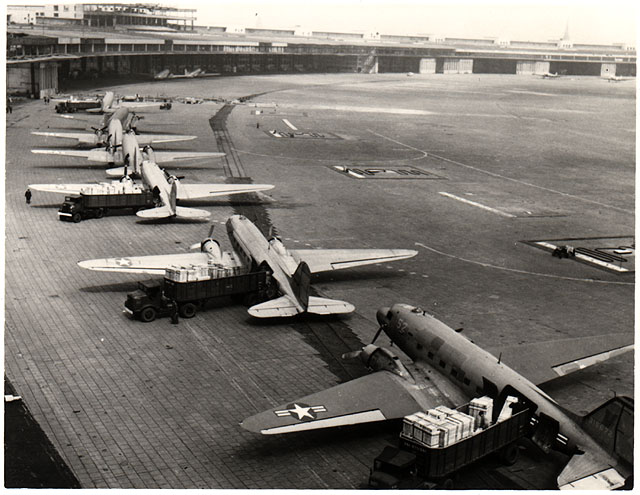
Seven U.S. Air Force Douglas C-47 airplanes
unloading cargo at Tempelhof Airport,
Berlin, Germany during Operation Vittles
(Berlin Airlift).  Photo: U.S. Airforce
Imposing a blockade on West Berlin, cutting off all land/rail routes was described as “…. one of the most ruthless efforts in modern times to use mass starvation for political coercion... "  For almost a year, the Allies made 450 daily airlifts with food and supplies, preventing the over two million people from starving. 


The blockade actually backfired on the Soviets as the airlifts made the blockade moot and it provoked a real fear of war in the West.  Eleven months later, Stalin lifted the blockade.


Newsreel clip:


Monday, June 17, 2013

June 17: Truman Halts Investigation

On this date in History.... June 17, 1943:

Sen. Harry Truman is asked not to investigate a suspicious war plant in Washington State. 

Truman was chairing a committee on possible war profiteering when this plant caught his attention. FDR’s Secretary of War, Harry Stimson, was one of the very VERY few who knew this plant was secretly involved in activities connected to the Manhattan Project. When asked to curb the investigation with no real explanation given, Truman, who was described as “a veteran and a patriot”, told Stimson to “say no more”, and the inquiry stopped.  

It was only after FDR’s death and Truman became President did he find out the nature of the Manhattan Project.


Thursday, April 25, 2013

April 25: White House Bowling Alley

On this date in History .... 1947:


Harry Truman officially opens the first White House bowling alley by rolling the first ball and knocking down seven of the ten pins, one of which is now on display at the Smithsonian. Eisenhower closed the alley in 1955 and another one was built later in the building next door.  

The Johnsons and the Nixons used the bowling facility frequently. Truman’s favorite activity was poker and he didn’t bowl much while in office.


White House Bowling Alley 1948


Wednesday, April 17, 2013

April 17: Political Mudslinging

On this date in History ... 1950:

Time magazine publishes an article about the story circulating about political mudslinging between Florida incumbent Sen. Claude Pepper and his opponent, George Smathers.
 
The story, which has become the icon of how words can be used to distort one’s image, first appeared in an Iowa newspaper and grew rapidly on the political grapevine.  While it is denied that Smathers ever made such a speech, it followed the campaign and cost Pepper his seat in the Senate, much to the joy of Harry Truman who wanted Pepper out of office due to Pepper having been part of a failed attempt to “dump Truman” from the Democratic ticket.
 
The story was:
 
"Are you aware that Claude Pepper is known all over Washington as a shameless extrovert? Not only that, but this man is reliably reported to practice nepotism with his sister-in-law, he has a brother who is a known homo sapien, and he has a sister who was once a thespian in wicked New York. Worst of all, it is an established fact that Mr. Pepper, before his marriage habitually practiced celibacy."

Voters told reporters that they weren’t quite sure what words like “extrovert” and “nepotism” and “thespian” meant but they were sure they were connected to bad, immoral or illegal activities.

Saturday, April 13, 2013

April 13: Hudner Receives Medal of Honor


On this date in History …. April 12, 1951:


Lt. Thomas Hudner is awarded the Medal of Honor for intentionally crashing his plane into a mountain to try to save U.S. Navy Ensign Jesse Leroy Brown, the first African-American Navy pilot.  Hudner was sure his career was over when he crashed “a perfectly good plane” in an attempt to save a black man. 


At a very young age, Jesse knew he wanted to be an aviator so he worked hard in school, graduated second in his class at Eureka High School.  The was then accepted at Ohio State and became one of the 1% African-American population in that college. When he entered Navy pilot school, he was the only African-American in a class of 600.


While on one of many flying missions, during the Korean War, to support and protect the U.S.S. Leyte, his plane was hit and losing oil pressure.  He crash landed on a snowy mountain, 5300 feet in elevation. While he was able to open the hatch and wave to the other pilots to send help, he was unable to leave the plane as his legs were pinned by the wreckage.

The other pilots worked to protect Brown from the hordes of Chinese in the area, but after half an hour, Lt. Hudner decided to kick it up a notch. Without alerting or asking permission from his commander, Hudner turned his plane into the wind to slow down his speed and crashed his plane about a 100 yards from Brown.  Hudner said years later, about this decision:

“I knew what I had to do. I was not going to leave him down there for the Chinese. Besides, it was 30 degrees below zero on that slope, and he was a fellow aviator. My association with the Marines had rubbed off on me. They don’t leave wounded Marines behind.”

Rescue helicopters arrived with axes to try to get Brown out of the wreckage.  In addition to fighting extreme cold temperatures, there was also smoke coming from the wreckage.  Hudner threw snow on the fire, but only managed to somewhat control it but unable to put it out.  Darkness was falling and the helicopters were not equipped to fly at night.  Brown was barely conscious and still trapped.  The last thing he said to Hudner was “Tell my wife Daisy I love her.”  The rescue team was forced to fly off and the order came down from their commander for an air strike to napalm the crash site, cremating the frozen body of Ensign Brown.

Hudner after the failed rescued figured he would be reprimanded and his Naval career ended for crashing a perfectly fine Corsair aircraft in a failed attempt to save one man, a black man at that. However, Lieutenant Hudner’s command did something totally unexpected, they instead recommended him for the nation’s highest combat award, the Medal of Honor. Additionally the deceased Ensign Brown was awarded the second highest honor for combat pilots, the Distinguished Flying Cross.”  (source: www.rokdrop.com)

When Hudner received his Medal of Honor at the White House, there was one lone African American woman standing next to him.  Daisy Brown, the wife of Ensign Brown, watched as Hudner received the medal for his heroic attempts to save her husband and she received the last message from her husband, “Tell Daisy I love her.”

In 1972 a destroyer was named the USS Jesse L. Brown.  Daisy and Thomas Hudner were there for the christening ceremony.

Thursday, April 11, 2013

April 11: Truman Fires MacArthur

On this date in History .... 1951:


Truman fires Gen. Douglas MacArthur in what became known as the most public and controversial military firing. 


MacArthur was a brilliant general and strategist and proved it a number of times in the Pacific theater during WWII.  However, he wanted to repeat those successes in Korea but Truman did not want to extend the Korean conflict to include a confrontation with the Chinese. MacArthur assured Truman that the chances of a Chinese invasion into Korea were “slim” but when hundreds of thousands of Chinese moved into North Korea, Truman fired MacArthur, much to the ire of many of the American public.  

MacArthur was given parades and a hero’s welcome upon his return, and he addressed Congress with his famous line of “Old soldiers never die … they just fade away.”


Saturday, January 5, 2013

January 5: Truman's "Fair Deal"

On this date in History .... 1949:

Truman tries to piggyback FDR’s “New Deal” ideas by offering a “Fair Deal” in his State of the Union address, stating that the people of the U.S. had a right to expect a fair deal from their government. 
 
He wanted to increase minimum wage, offer a national health care program, improve public housing, federal aid for education, assistance to farmers and more.  However, coming right at the end of World War II, these ideas sounded too close to socialism and an anti-communist attitude threw up barriers to Truman’s ideas. 
 
He did get a few changes passed, such as increasing minimum wage from 40 cents to 75 cents an hour but by 1950, the Korean and Cold Wars were detracting his attention from domestic matters.
 
.

Monday, December 24, 2012

December 24: Walter-McCarren Act

On this date in History .... 1952:

The Walter-McCarren Act goes into effect, changing some of the criteria for immigrants to be admitted to the U.S.  While it did little to change the quota system that was already in place, it still gave preference to European immigrants, specifically England, Ireland and Germany, giving these three countries two-thirds of the allocated slots available.  But it did remove some racial barriers that had previously excluded Japan and China, which were assigned very small quotas. 
 
The Act called for a more intense screening to make sure anyone labeled a subversive was not allowed entry and those from communist or communist-front organization were to be deported.  “In defending the act, Senator McCarren declared, "If this oasis of the world should be overrun, perverted, contaminated, or destroyed, then the last flickering light of humanity will be extinguished."
 
President Harry S. Truman took a very different view, calling the legislation "un-American" and inhumane. When the bill was passed in June 1952, Truman vetoed the bill. Congress overrode his veto, and the act took effect in December.”


Thursday, December 20, 2012

December 20: Soviet Code Broken

On this date in History ..... 1946:

Meredith Gardner broke a Soviet code that revealed Soviet espionage in the Manhattan Project, and Soviet activity in the Treasury Dept, the State Dept and even the White House. The code breaking, a collaboration between the US and the UK to break Soviet coded messages, was known as the VENONA Project. It was so secret that Pres. Roosevelt and Truman knew nothing about it and led to evidence used in such spy cases as Julius and Ethel Rosenberg.
 
While Mr. Gardner was the key man in breaking this code, most of the code breakers were young women.

Wednesday, November 21, 2012

November 21: Truman Ride in Submarine

On this date in History .... 1946:

Harry Truman becomes the first president to travel in a submerged “modern” submarine.  
 
The distinction separates his hour-long 450 foot submersion from that of Theodore Roosevelt, who took a few “short-dives” in an archaic torpedo boat” in 1905.
 
The U-2513 submarine that Truman traveled in was developed by the Germans, but too late to do any real impact in the war and was surrendered to the Allies in May 1945. A U.S. submarine division went to Northern Ireland to learn about the sub, which included having to learn German at the same time.
 
The sub had technological advances that allowed it to stay submerged for longer periods of time. When the division sailed this sub to the U.S., the crew included eight Germans who served as the original crew on the sub.


The trip earned Truman certification that he was now an “Honorable Member of the Ancient Order of Deep Dunkers.”


Photo Courtesy of: www.trumanlibrary.org


Thursday, November 1, 2012

November 1: Harry Truman Assassination Attempt

On this date in History ..... 1950:

An assassination attempt on President Harry Truman fails.
 
The White House was under renovation and the Trumans were staying in Blair House. A pair of wanna-be-assassins simply strolled up the steps of Blair House to the front door and opened fire, not even knowing for sure if Truman was in the building.  They never made it inside the house. A White House policeman was hit but managed to kill one of the intruders before dying himself later that day.
 
Truman, who was upstairs, heard the commotion and watched part of the exchange from an upstairs window before law enforcement told him to get back inside. The other gunman was sentenced to death but a week before his execution, Truman commuted the sentence to life imprisonment, then Carter commuted the life sentence and the gunman was released in 1979.  He died in Puerto Rico at the age of 80 in 1994.

Both assassins were members of the Puerto Rico Nationalist Party and thought killing the President would advance the cause of Puerto Rico independence, even though Truman was supportive of Puerto Rico self-sufficiency. 

Click here to view the Newsreel of the event

Apparently unfazed by the attempt on his life, Truman kept his scheduled appointments for the day. "A President has to expect these things," he remarked dryly.    

Sunday, October 28, 2012

October 28: Madonna of the Trail

On this date in history ..... 1928:

The Indiana “Madonna of the Trail” is dedicated in Richmond, Indiana. 

The 9th in a series of 12, the Madonna statue is placed in each state in which the “National Road”  (i.e. U.S. 40) passes, to honor the pioneer mothers of covered wagon days. The National Road, sometimes referred to as the Ocean-to-Ocean highway, was the first interstate highway established by an act of Congress in 1806. Judge Harry S. Truman, then president of the National Old Trails Road Association, guaranteed the funds for these monuments, and attended the dedication of the Indiana monument. 

photo courtesy: ttp://www.waynet.org/waynet/spotlight/2005/051017-madonna.htm


It is indicated Truman may have attended many of the other dedications, but confirmation this at each monument could not be found. However, this project was very important to Truman and it is said that he was a “driving force” behind the project. “On July 27, 1998, at Norfolk, Virginia, the aircraft carrier USS Harry S. Truman, was commissioned. A 20" x 24" color photograph of the ‘Madonna of the Trail’ hangs in a place of honor in its Captain's Quarters.”
Source: http://www.santafetrailscenicandhistoricbyway.org/madona.html

Created by German born artist August Leimbach, (who came to America in 1910 when he was 28 years old), the ten foot tall woman stands on a six foot base and weighs five tons.  All of the twelve statues are identical. 

All but two or three of the statues face west, the direction these pioneer women were traveling. The first Madonna was dedicated in Springfield OH on July 4, 1928.  The order of the remaining eleven’s dedication are:

  
2nd – Wheeling WV – July 7, 1928
3rd – Council Grove KS – Sept 7, 1928
4th – Lexington, MO – Sept 17, 1928
5th – Lamar, CO – Sept 24, 1928
6th – Albuquerque, NM – Sept 27, 1928
7th – Springerville, AZ – Sept 29, 1928
8th – Vandalia, IL – Oct 26, 1928
9th – Richmond IN – Oct 28, 1928
10th – Beallsville, PA – Dec 8, 1928
11th – Upland, CA – Feb 1, 1929
12th – Bethesda, MD – April 19, 1929