On this date in history .... August 3, 1941:
Gas sales were limited in the U.S. during WWII.
Actually,
gas wasn't what they were rationing at all. The main purpose of the
restrictions on gas purchasing was to conserve tires. Japanese armies in the Far East had cut the
U.S. off from its chief supply of rubber.
There were four rationing classifications:
- An "A"
classification, which could be had by almost anyone, entitled the holder to
four gallons a week.
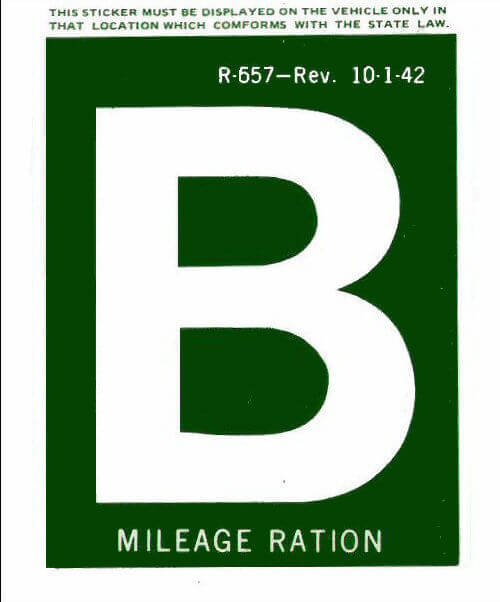
- A "B" classification was worth about eight
gallons a week.
- "C" was reserved for important folk, like doctors.
- The magic "X" went to people whose very survival required that
they be able to purchase gasoline in unlimited quantities--rich people and
politicians, for example.
Gas rationing began on a nationwide
basis on December 1, 1942. It ended on Aug 15, 1945. Speed limits were 35 MPH
for the duration. For a short time in 1943, rations were reduced further and
all pleasure driving was outlawed.
The first nonfood item rationed
was rubber. The Japanese had seized plantations in the Dutch East Indies
that produced 90% of America's raw rubber. President Roosevelt called on
citizens to help by contributing scrap rubber to be recycled, old tires, old
rubber raincoats, garden hose, rubber shoes, bathing caps.
By the end of 1942, half of U.S automobiles were issued an 'A' sticker
which allowed 4 gallons of fuel per week. That sticker was issued to
owners whose use of their cars was nonessential. Hand the pump jockey
your Mileage Ration Book coupons and cash, and she (yes, female service station
attendants because the guys were over there) could sell you three or
four gallons a week, no more. For nearly a year, A-stickered cars were
not to be driven for pleasure at all.
The green 'B' sticker was for driving deemed essential to the war effort;
industrial war workers, for example, could purchase eight gallons a week.
Red 'C' stickers indicated physicians, ministers, mail carriers and railroad
workers. 'T' was for truckers, and the rare 'X' sticker went to members
of Congress and other VIPs. Truckers supplying the population with
supplies had a T sticker for unlimited amounts of fuel.
Sources for this article:
http://www.straightdope.com/columns/read/353/how-was-gas-rationing-handled-during-world-war-ii
http://www.ameshistoricalsociety.org/exhibits/events/rationing.htm
On this date in History .... 1941:
The Office of Price Administration mandates the first
rationing program of the war by mandating no one person could own more than
five tires and any tires owned in excess of five had to be turned in.
War with the Japanese made it difficult to
get rubber from the Dutch Indies, which was where over 90% of the U.S.’s raw
rubber came from, and what rubber could be obtained was used for war supplies.
People were urged to save their tires by carpooling and driving less. Posters sent messages such as “When you ride
alone, you ride with Hitler!”
Scrap
rubber drives collected tires, water hoses, swimming caps, gloves, raincoats,
baby rubber pants and anything else that could be recycled for the war.
Gas rationing began on December 1, 1942, not
so much as a way to save gas but more as a way to reduce driving which would
save the use of tires, which would decrease the civilian demand for rubber. Tire
rationing ended on December 31, 1945.
.