Showing posts with label Roosevelt. Show all posts

Saturday, August 3, 2013

August 3: Gas Rationed in WWII

On this date in history .... August 3, 1941:

Gas sales were limited in the U.S. during WWII. 

Actually, gas wasn't what they were rationing at all. The main purpose of the restrictions on gas purchasing was to conserve tires. Japanese armies in the Far East had cut the U.S. off from its chief supply of rubber.

There were four rationing classifications:

  • An "A" classification, which could be had by almost anyone, entitled the holder to four gallons a week. 
  • A "B" classification was worth about eight gallons a week. 
  • "C" was reserved for important folk, like doctors.  
  • The magic "X" went to people whose very survival required that they be able to purchase gasoline in unlimited quantities--rich people and politicians, for example.

Gas rationing began on a nationwide basis on December 1, 1942. It ended on Aug 15, 1945. Speed limits were 35 MPH for the duration. For a short time in 1943, rations were reduced further and all pleasure driving was outlawed.  

The first nonfood item rationed was rubber.  The Japanese had seized plantations in the Dutch East Indies that produced 90% of America's raw rubber.  President Roosevelt called on citizens to help by contributing scrap rubber to be recycled, old tires, old rubber raincoats, garden hose, rubber shoes, bathing caps. 

By the end of 1942, half of U.S automobiles were issued an 'A' sticker which allowed 4 gallons of fuel per week.  That sticker was issued to owners whose use of their cars was nonessential.  Hand the pump jockey your Mileage Ration Book coupons and cash, and she (yes, female service station attendants because the guys were over there) could sell you three or four gallons a week, no more.  For nearly a year, A-stickered cars were not to be driven for pleasure at all. 
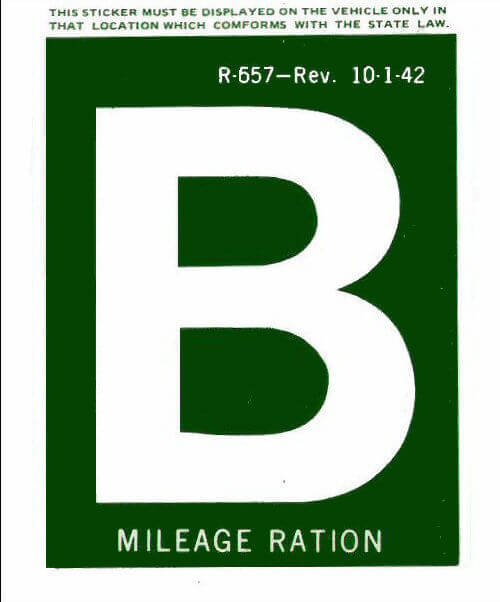
The green 'B' sticker was for driving deemed essential to the war effort; industrial war workers, for example, could purchase eight gallons a week.  Red 'C' stickers indicated physicians, ministers, mail carriers and railroad workers.  'T' was for truckers, and the rare 'X' sticker went to members of Congress and other VIPs.  Truckers supplying the population with supplies had a T sticker for unlimited amounts of fuel.


Sources for this article:
http://www.straightdope.com/columns/read/353/how-was-gas-rationing-handled-during-world-war-ii
http://www.ameshistoricalsociety.org/exhibits/events/rationing.htm

Friday, July 12, 2013

July 12: Theodore Roosevelt Jr

On this date in History .... July 12, 1944:

General Theodore Roosevelt II, eldest son of Franklin D. Roosevelt, died of a heart attack in his tent in France, approximately one month after the Utah Beach landing, at the age of 56. 

Throughout World War II, he suffered from health problems and walked with a cane. He also had heart trouble. On the day of his death he had been selected by General Omar Bradley for promotion to major general and orders had been cut placing him in command of the 90th Infantry Division. These recommendations were sent to General Dwight D. Eisenhower for approval, but when Eisenhower called the next morning to approve them, he had to be told that Roosevelt had died during the night.  

He was buried at the American cemetery in Normandy. He now lies next to his younger brother, Lieutenant Quentin Roosevelt. Quentin, a pilot, had been killed in France during World War I and was initially buried at Chamery, but was exhumed in 1955 and moved to the Normandy Cemetery, in order to be re-interred next to his brother. 


See also my blog of June 6th:  http://thimblefulsofhistory.blogspot.com/2013/06/june-6-d-day-theodore-roosevelt-jr.html


Sunday, June 9, 2013

June 7: King George VI visits U.S.

On this date in history ... June 7, 1939:

King George VI becomes the first British monarch to visit the U.S. 

FDR’s invitation to the royal couple did not go unnoticed as no reigning British Monarch had ever set foot on American soil, not even in colonial times.  With Europe poised on the brink of war, Franklin Roosevelt realized the necessity of building a closer relationship between the two countries.

In addition to hosting a White House state dinner, the Roosevelts also hosted a picnic style luncheon at their home in Hyde Park (NY) where FDR’s mother was “horrified” that the King and Queen were served hot dogs on the front porch!  

George VI at the picnic at Top Cottage, seated with Sara Delano Roosevelt (FDR's mother, right), New York Governor Herbert Lehman, and Elinor Morgenthau (wife of Treasury Secretary Henry Morgenthau, Jr., left), June 11, 1939, Hyde Park, NY. (FDR Library)

Thursday, June 6, 2013

June 6: D-Day & Theodore Roosevelt Jr.

On this date in History .... June 6, 1944:

The day after General Eisenhower gave the order to commence Operation Overlord, which would become known as "D-Day", and would become the largest amphibious military operation in history. Some of the numbers of the day include:

  • 6000 ships and landing crafts, carrying ....
  • 176,000 troops
  • 822 aircraft that would drop parachutists in Normandy
  • 13,000 additional aircraft to provide cover and air support.
Hitler believed the invasion was a fake and a diversion and refused to release German troops to the area. 


Theodore Roosevelt Jr., the eldest son of Theodore and Edith Roosevelt, was the only general on D-Day to land by sea with the first wave of troops. He would be the oldest man involved in the invasion (age 56) and the only man to serve with his son on D-Day at Normandy. 

He heard the first wave landing craft had drifted more than a mile off target.  Armed with only a pistol, he took off walking with his cane to find the causeways to be used as an inland landing point. He then returned to the commanders and shared the information, coordinating the attack.  His famous words at this point were, "We'll start the war from right here!"

Roosevelt died a month later of a heart attack in his tent.  He was buried in the American cemetery in Normandy.  

His Medal of Honor Citation reads:

"Citation: for gallantry and intrepidity at the risk of his life above and beyond the call of duty on 6 June 1944, in France. After 2 verbal requests to accompany the leading assault elements in the Normandy invasion had been denied, Brig. Gen. Roosevelt's written request for this mission was approved and he landed with the first wave of the forces assaulting the enemy-held beaches. He repeatedly led groups from the beach, over the seawall and established them inland. His valor, courage, and presence in the very front of the attack and his complete unconcern at being under heavy fire inspired the troops to heights of enthusiasm and self-sacrifice. 

Although the enemy had the beach under constant direct fire, Brig. Gen. Roosevelt moved from one locality to another, rallying men around him, directed and personally led them against the enemy.  Under his seasoned, precise, calm, and unfaltering leadership, assault troops reduced beach strong points and rapidly moved inland with minimum casualties. He thus contributed substantially to the successful establishment of the beachhead in France."


Tuesday, April 9, 2013

April 8: Beer for the White House

On this date in  History .... 1933:

When Pres Franklin Roosevelt signed the Cullen-Harrison Act on March 23rd,  allowing the manufacture & sale of 3.2 beer & light wines during Prohibition, he made his famous remark; “I think this would be a good time for a beer.” The Cullen-Harrison Act became law on April 7, 1933, and on April 8, 1933, Anheuser-Busch sent a team of Clydesdale horses to deliver a case of Budweiser to the White House.  


Tuesday, April 2, 2013

April 1: Father-Son Medals of Honor

On this date in History .... 1942:

Douglas MacArthur is awarded the Medal of Honor for his invasion of the Philippines. This made him one of only two sets of father-son recipients of the Medal of Honor.  MacArthur’s father rec’d the MOH during the Civil War.  The other father-son recipients were President Theodore Roosevelt for leading the charge on San Juan Hill and his son, Brigadier General Theodore Roosevelt Jr. for actions on D-Day in WWII.

.


Thursday, February 14, 2013

February 14: T. Roosevelt Suffers Double Loss

On this date in History .... 1884:

Theodore Roosevelt’s wife and mother die hours apart.  His mother died of typhoid fever and his wife died of Bright’s disease, a kidney illness.
 
Roosevelt was devastated by the double loss.  He had his sister raise his daughter Alice and headed to the Dakota territories where he ranched and even served as sheriff for a couple of years. He came back to the east coast in 1886 and got re-involved in politics, becoming President in 1901.
 
.

Wednesday, November 7, 2012

November 7: FDR Wins 4th Term

On this date in History .... 1944:

FDR wins an unprecedented 4th term and is the first and only president to serve more than 2 terms. This prompted Congress to pass the 22nd amendment 1947 to limit the president to two consecutive terms.  Until this point, 2 terms had been either voluntarily following George Washington’s example, or failed attempts at a 3rd term (T. Roosevelt ran for a 3rd term but lost in 1912).   He was president during two of America’s worst crisis periods:  The Great Depression and World War II.

Roosevelt pioneered the 100-day yardstick that measures a President’s effectiveness in office soon after elected. "The first hundred days of the New Deal have served as a model for future presidents of bold leadership and executive-legislative harmony," said Anthony Badger in his book “FDR: The First Hundred Days.”

He was first elected in the fourth year of a depression that was affecting countries the world over. He called Congress into a special session and kept them busy for three months, passing what is called his Alphabet Soup of programs and bills to get America working, such as the WPA, CWA, NRA (Nat’l Recovery Administration), TVA, SEC, FHA, PWA, NLRB, and more.

That first year, “Roosevelt got 15 major bills through Congress in his first 100 days. "Congress doesn't pass legislation anymore—they just wave at the bills as they go by," said humorist Will Rogers.”

(quote source: http://www.usnews.com/news/history/