Showing posts with label Johnson. Show all posts

Friday, March 14, 2014

March 13: First Impeachment Trial

On this date in History .... March 13, 1868:

The first impeachment trial of a United States president begins against President Andrew Johnson, accused of violation of the controversial Agent of Tenure Act.  

The Act was passed by Congress in spite of Johnson’s veto against it.  

Johnson had tried to remove people from office who opposed Johnson’s Reconstruction plans (which Congress considered too lenient) without Senate approval. The Tenure Act forbid this from happening. Johnson chose to ignore the Act and removed Secretary of War Edward Stanton from office. 

Johnson was found not guilty and remained in office, although he chose not to run for re-election.

Photo courtesy:  http://staff.harrisonburg.k12.va.us/

Thursday, August 8, 2013

August 7: Gulf of Tonkin Resolution signed

On this date in History..... August 7, 1964:

Congress overwhelmingly passes the Gulf of Tonkin Resolution (only 2 “no” Votes in the Senate; it passed the House unanimously), after U.S. boats were torpedoed in the Gulf of Tonkin (also known as the USS Maddox Incident) on August 2 and again on August 4. This gave Pres. Johnson, in his first year in office, almost unlimited power and “the right to take all necessary measures to repel any armed attack against the forces of the United States and to prevent further aggression."  

Johnson used this resolution as his authority to escalate U.S. military involvement in the Vietnam War, and saw his popularity soar due to his “restrained handling of the crisis.”  The Johnson Administration used this Resolution as their green light to begin heavy bombing and increase troops in Vietnam.  

During the Nixon administration, the resolution was repealed, over Nixon’s objections. Realizing the need to restore limits on presidential authority to engage in war activity, Congress passed the War Powers Resolution in 1973 which requires the president to consult with Congress before engaging U.S. forces in hostile actions.

Sunday, July 21, 2013

July 21: Mary Edward Walker

On this date in History .... July 21, 1861:

Dr. Mary Walker, a Civil War surgeon and the nation's first female surgeon , was awarded the Medal of Honor, for her efforts at Bull Run on July 21,1861, becoming the only woman to receive the Medal of Honor and one of only eight civilians to ever receive it. She was recommended for the medal after the war by General William Tecumseh Sherman. President Andrew Johnson signed his approval in 1865. 

Her name was removed from the honor list of awardees in 1917, along with others, when the terms used to designate eligibility for the award were reappraised. She refused to surrender the medal, however, and continue to wear it for the rest of her life. In 1977, thanks to the efforts of her family and a Congressional reappraisal of her achievements, the honor was restored.

Mary Walker
Dr. Walker was a militant feminist before the word became part of our vocabulary and worked especially hard on "dress reform" as part of women's emancipation.

Born a farmer’s daughter, she did not wear women’s clothing doing farm labor because it was too restricting and refused to “dress as a woman” while doing medical work during the war. The only women in her 1855 medical class, after graduation she married a doctor but kept her own name. She volunteered as a surgeon, working on the front lines.

She refused to wear cumbersome skirts while doing medical work during the Civil War. On April 10, 1864, when she took a wrong turn on a road, she was captured and accused of being a spy since she was “disguised” in men’s clothing, making her the first female POW.  Upon release, she worked in a women’s prison, where the women prisoners didn’t like her wardrobe of long pants and a tunic & asked for a “real” (man) doctor. 

Mary Walker
After the war she became a writer/speaker in the suffrage movement, particularly on the topic of women’s clothing.  She was arrested for impersonating a man several times, although she argued that Congress had awarded her special permission to dress in this way.


.

Wednesday, June 12, 2013

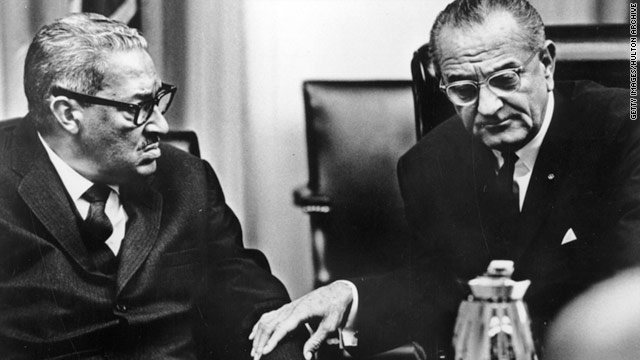
June 13: Thurgood Marshall

On this date in History .... June 13, 1967:

Lyndon Johnson nominated Thurgood Marshall for the U.S. Supreme Court.  

Marshall was confirmed by Congress 69-11 and sworn in on August 30, making him the first African-American to sit on the Supreme Court. 

The great-grandson of slaves, he became an attorney and argued cases before the Supreme Court, winning 29 of them, including the ground breaking Brown v. Board of Education in 1954. 

He served 24 years on the Court.

.

Sunday, June 9, 2013

June 9: Johnson and the Domino Theory

On this date in History .... June 9, 1964:

Johnson ignores a CIA report that challenges the domino theory.  

The “domino theory” was a product of the Cold War and justified the U.S. involvement in helping smaller countries avoid communism. It was a belief that if one country fell to communism, then surrounding countries would “fall like dominoes”.  The CIA report stated that Cambodia would be the only country to fall immediately but even if Vietnam and Laos fell to Communism, there were enough American Allies in the Pacific to dissuade N. Vietnam and China from aggression.  

Johnson, who held strongly to the domino theory, chose to ignore this report, eventually committing over 500,000 troops to Vietnam to try to thwart the spread of Communism.

Monday, May 20, 2013

May 16: President Andrew Jackson's Impeachment Vote

On this date in History ... May 16, 1868:


The U.S. Senate votes against impeaching President Andrew Johnson and acquits him of committing "high crimes and misdemeanors."  The main core of the 11 charges was Johnson’s aversion to the Reconstruction Plan after the Civil War.  The War Dept, and Sec’y of War Edwin Stanton, was in charge of implementing the plan and Johnson is charged with illegally removing Stanton from office. By a vote of 35-19, Johnson was acquitted and finished out his term. 

Presidents Johnson and Clinton are the only presidents for whom the impeachment process went as far as a Senate trial. Nixon resigned before the House of Representatives could vote on impeachment.

Tuesday, January 22, 2013

January 22: LBJ Dies

On this date in History .... 1973:

Former President Lyndon Baines Johnson dies at the age of 64. 

Johnson’s pre-political career was that of a high school teacher of debate and public policy. He was the first president to appoint an African-American, Thurgood Marshall, to the Supreme Court. 

Johnson had wanted to “carve out a legacy as the creator of a Great Society” but had to live with the disappointment that his social programs were overshadowed by his escalation of the Vietnam War. 

Johnson had always said the “…when the Great Society dies, I’ll die, too.” As he watched Nixon’s second inaugural, on Jan 20th, he heard many of his social programs being dismantled.  The next day, he watched Nixon announce the cease fire in Vietnam, something that Johnson had been unable to achieve.  The following day, Johnson died of a heart attack.


Tuesday, January 8, 2013

January 8: Right to Vote Veto Overridden

On this date in History .... 1867:

Congress overrides President Andrew Johnson’s veto of a bill allowing “all men” the right to vote in the District of Columbia. 
 
This was the first bill giving black men the right to vote. It prohibited the right to vote to those who were on welfare or charity, those who were under guardianship, those who had been convicted of major crimes, and those who had voluntarily aided Confederate troops or spies during the war. 
 
In 1870, the Republican dominated Congress passed the 15th Amendment preventing all states from prevention any male the right to vote.
 
.

Wednesday, December 5, 2012

December 5: 1st Vietnam Medal of Honor

On this date in History .... 1964:

Capt. Roger Donlon became the first Vietnam soldier and the first member of Special Forces to receive the Medal of Honor for his actions on July 6th 1964.

The Special Forces commander single-handed killed a 3-man enemy team during a surprise attack in which he and his troops were outnumbered three-to-one and resulted in 55 killed with 65 wounded. When he was hit in his stomach, he stuffed a shirt into the wound, tightened his belt, and refused medical care, even though he was wounded a total of four times during the fie-hour battle, while he dragged other wounded men out of danger  and hauled supplies to the gunners as they defended their position for the long five hours. 

When Pres. Johnson  gave Donlon the medal, Donlon had the nine remaining members of his Special Forces team with him.  He told Johnson, “The medal belongs to them, too."

Donlon was the eighth of ten children.  His father and all four of his brothers served in the military. He attended West Point for two years, eventually becoming a Special Forces officer of the Green Berets.

.

the wound, tightened his belt, and refused medical care while he dragged other wounded men out of danger and hauled supplies to the gunners as they defended their position for five hours. When Pres. Johnson gave Donlon the medal, Donlon had the nine remaining members of his Special Forces team with him. He told Johnson, "The medal belongs to them, too."