On this date in History .... August 6, 1861:
Lincoln signs the Confiscation
Act, the first legislative act toward emancipation of slaves.
The Act recognized
that slaves doing the work on a plantation were freeing up the white Southerners
to have plenty of time to fight in the war.
Slaves were also used for menial tasks in the war, also enabling the war
effort.
The Act stripped slave owners of
any claim to slaves and made them “confiscated property” of the United
States. The Act stated that any slave
who worked for “disloyal masters in some form of work against the United
States” were free.
The law was not enforced uniformly with some Union officers
returning slaves back over Confederate lines.
Union (Democrat) Gen’l McCook was so “obliging” in returning slaves to
their owners that he was praised in Confederate newspapers.
Tuesday, August 6, 2013

August 5: Lincoln signs Tax Bill
On this date in History .... August 5, 1861:
Lincoln signs the Revenue Act, imposing a 3% tax on incomes over $800 (comparable to $30,000 +/- in 2010 dollars) to pay for the Civil War. He asked multiple Cabinet members about his constitutional authority to impose such a tax. Lincoln’s tax law was repealed in 1871 but was replaced in 1909 by the 16th amendment (ratified in 1913) which set in place the income tax system we all “enjoy” today.
Lincoln signs the Revenue Act, imposing a 3% tax on incomes over $800 (comparable to $30,000 +/- in 2010 dollars) to pay for the Civil War. He asked multiple Cabinet members about his constitutional authority to impose such a tax. Lincoln’s tax law was repealed in 1871 but was replaced in 1909 by the 16th amendment (ratified in 1913) which set in place the income tax system we all “enjoy” today.
Sunday, August 4, 2013
August 4: Gov. Oliver P. Morton
On this date in History .... August 4, 1823:
Oliver Perry Throck Morton is born in Salisbury (Wayne County) Indiana. (Salisbury no longer exists but was located between
Richmond and Centerville on the east side of the state.) The family name of “Throckmorton” was
shortened to “Morton” but the males in the family carried the “Throck” name as
a middle name.
Morton was the first Indiana-born governor and served as the “war-time governor” of Indiana for six years (Jan. 16, 1861–Jan. 23, 1867) and strongly supported the Union during the Civil War. He began his political career as a Democrat but was thrown out of the party because of his anti-slavery stance. As governor, he raised men and money for the Union army, and successfully suppressed Indiana's Confederate sympathizers.
 |
| Gov. Oliver Morton Photo courtesy of www.nps.gov |
Morton was the first Indiana-born governor and served as the “war-time governor” of Indiana for six years (Jan. 16, 1861–Jan. 23, 1867) and strongly supported the Union during the Civil War. He began his political career as a Democrat but was thrown out of the party because of his anti-slavery stance. As governor, he raised men and money for the Union army, and successfully suppressed Indiana's Confederate sympathizers.
“Morton immediately dissolved the General Assembly and announced his intent to administer the state without its representatives. As the state approached bankruptcy, Morton successfully solicited the donation and loan of millions of dollars in private money that were then used to fund the government. He continued to harass and suppress the activities of his political opponents whom he occasionally accused of treason.
It is thought that because of his scrupulous honesty during this period of one-man rule he was able to escape post-war retribution for his actions. He was reelected governor in 1864 and served until his appointment to the U.S. Senate in 1867. “
quote source: http://www.nps.gov/resources/person.htm?id=103
During his early tenure
as governor, Morton believed that war was inevitable and began to prepare the
state for it. He appointed men to cabinet positions who were well known to be
against any compromise with the southern states. He established a state arsenal
and employed seven hundred men to produce ammunition and weapons without
legislative permission and made many other preparations for the war to come.
When open war finally
broke out on April 12, 1861, he telegraphed President Abraham Lincoln three
days later to announce that he already had 10,000 soldiers underarms ready to
suppress the rebellion.
“In 1865, when Morton had a paralytic stroke
and went to Europe for treatment, the President entrusted him with a
confidential mission to Napoleon III concerning
the withdrawal of the French troops from Mexico.” (quote source: http://www.nndb.com/people/209/000050059/
In 1867, he was elected
to the U.S. Senate where he served until his death in 1877.
 |
| Oliver P. Morton Home, Centerville Indiana. For more photos, explore this link: http://www.hmdb.org/Marker.asp?Marker=264 |
Saturday, August 3, 2013
August 3: Gas Rationed in WWII
On this date in history .... August 3, 1941:
Gas sales were limited in the U.S. during WWII.
Actually, gas wasn't what they were rationing at all. The main purpose of the restrictions on gas purchasing was to conserve tires. Japanese armies in the Far East had cut the U.S. off from its chief supply of rubber.
There were four rationing classifications:
 Gas rationing began on a nationwide
basis on December 1, 1942. It ended on Aug 15, 1945. Speed limits were 35 MPH
for the duration. For a short time in 1943, rations were reduced further and
all pleasure driving was outlawed.
Gas rationing began on a nationwide
basis on December 1, 1942. It ended on Aug 15, 1945. Speed limits were 35 MPH
for the duration. For a short time in 1943, rations were reduced further and
all pleasure driving was outlawed.
The first nonfood item rationed was rubber. The Japanese had seized plantations in the Dutch East Indies that produced 90% of America's raw rubber. President Roosevelt called on citizens to help by contributing scrap rubber to be recycled, old tires, old rubber raincoats, garden hose, rubber shoes, bathing caps.
By the end of 1942, half of U.S automobiles were issued an 'A' sticker which allowed 4 gallons of fuel per week. That sticker was issued to owners whose use of their cars was nonessential. Hand the pump jockey your Mileage Ration Book coupons and cash, and she (yes, female service station attendants because the guys were over there) could sell you three or four gallons a week, no more. For nearly a year, A-stickered cars were not to be driven for pleasure at all.
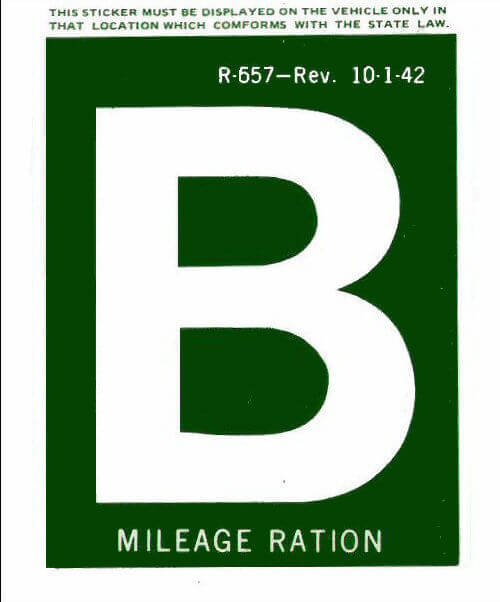
 The green 'B' sticker was for driving deemed essential to the war effort;
industrial war workers, for example, could purchase eight gallons a week.
Red 'C' stickers indicated physicians, ministers, mail carriers and railroad
workers. 'T' was for truckers, and the rare 'X' sticker went to members
of Congress and other VIPs. Truckers supplying the population with
supplies had a T sticker for unlimited amounts of fuel.
The green 'B' sticker was for driving deemed essential to the war effort;
industrial war workers, for example, could purchase eight gallons a week.
Red 'C' stickers indicated physicians, ministers, mail carriers and railroad
workers. 'T' was for truckers, and the rare 'X' sticker went to members
of Congress and other VIPs. Truckers supplying the population with
supplies had a T sticker for unlimited amounts of fuel.
Sources for this article:
http://www.straightdope.com/columns/read/353/how-was-gas-rationing-handled-during-world-war-ii
http://www.ameshistoricalsociety.org/exhibits/events/rationing.htm
Gas sales were limited in the U.S. during WWII.
Actually, gas wasn't what they were rationing at all. The main purpose of the restrictions on gas purchasing was to conserve tires. Japanese armies in the Far East had cut the U.S. off from its chief supply of rubber.
There were four rationing classifications:
- An "A" classification, which could be had by almost anyone, entitled the holder to four gallons a week.
- A "B" classification was worth about eight gallons a week.
- "C" was reserved for important folk, like doctors.
- The magic "X" went to people whose very survival required that they be able to purchase gasoline in unlimited quantities--rich people and politicians, for example.
The first nonfood item rationed was rubber. The Japanese had seized plantations in the Dutch East Indies that produced 90% of America's raw rubber. President Roosevelt called on citizens to help by contributing scrap rubber to be recycled, old tires, old rubber raincoats, garden hose, rubber shoes, bathing caps.
By the end of 1942, half of U.S automobiles were issued an 'A' sticker which allowed 4 gallons of fuel per week. That sticker was issued to owners whose use of their cars was nonessential. Hand the pump jockey your Mileage Ration Book coupons and cash, and she (yes, female service station attendants because the guys were over there) could sell you three or four gallons a week, no more. For nearly a year, A-stickered cars were not to be driven for pleasure at all.
Sources for this article:
http://www.straightdope.com/columns/read/353/how-was-gas-rationing-handled-during-world-war-ii
http://www.ameshistoricalsociety.org/exhibits/events/rationing.htm
Friday, August 2, 2013
August 2: Myra Bradwell, Woman Lawyer
On this date in History .... August 2, 1869:
Myra Bradwell
passed the Illinois Bar Exam at the age of 38, becoming one of the first women
lawyers in the country and the first woman lawyer in Illinois. (Arabella
Mansfield is credited with being the first woman to pass the bar (in Iowa) in
June 1869.) However, the Illinois Supreme Court denied Bradwell admission to
the bar, not because she was a woman …. but because she was a married woman. They were afraid that since a lawyer may be
held responsible for their actions, she might be arrested and “therefore she
would not be available to her husband.”
 |
| photo courtesy of Columbia law library.edu |
"The natural and proper timidity and delicacy which belongs to the female sex evidently unfits it for many occupations of civil
life....The paramount destiny and mission of women are to fulfill the noble and
benign office of wife and mother. This is the law of the Creator." [83
U.S. 130 at 141].
Her appeal to the
Illinois Supreme Court was denied but this time it WAS because she was a woman,
with one of the four reasons being that allowing her to practice law would
“open the floodgates” and the court feared civil offices would be filled with
women.
Bradwell appealed
the decision to the Supreme Court who also denied her access to practice law.
Illinois eventually passed laws to permit women to practice law and in 1890,
she was granted a license to practice law. Her license was granted munc pro tunc (“now for then”) and dated
1869, making her officially the first licensed woman lawyer in Illinois.
Bradwell was the
lawyer for Mary Todd Lincoln’s insanity trial in 1875 when Lincoln was declared
sane and released from the sanitarium.
(SEE ALSO MY BLOG OF JUNE 19 – MARY TODD LINCOLN)
In 1868, Bradwell
founded The Chicago Legal News, a
regional legal-news newspaper that was the highest circulated legal newspaper
for over two decades. She became very involved in married women’s property
rights, drafting a law in 1869 to protect the earnings of married women and to
protect the interest of widows in their husbands’ estates.
Her daughter
graduated law school in 1882 and continued to run the newspaper until 1925.
August 2: Happy Birthday!
Taking a little personal privilege here...
Two birthdays in my family today.
Born in 1960, my sister Sandy.
Born in 1984, my son John.
Happy birthday to both of them!
Thursday, August 1, 2013
August 1: "Ladies and Gentlemen .... Rock and Roll"
On this date in history .... August 1, 1981:
MTV makes its debut with the words (spoken by MTV creator John Lack), “Ladies and gentlemen …. rock and roll.”
Videos of songs were donated to the station for free until the value of videos on MTV was recognized by the record industry and they began putting big money into the production of videos. MTV was instrumental in promoting performers such as Michael Jackson, Madonna, Prince and Duran Duran, whose videos played heavily during the 80s.
The station also pushed the edge of cultural boundaries such as the airing of Madonna’s “Like a Prayer”, which was condemned by the Vatican. By the late 80s, MTV was producing its own shows, including the popular “Beavis and Butthead”.
MTV makes its debut with the words (spoken by MTV creator John Lack), “Ladies and gentlemen …. rock and roll.”
Videos of songs were donated to the station for free until the value of videos on MTV was recognized by the record industry and they began putting big money into the production of videos. MTV was instrumental in promoting performers such as Michael Jackson, Madonna, Prince and Duran Duran, whose videos played heavily during the 80s.
The station also pushed the edge of cultural boundaries such as the airing of Madonna’s “Like a Prayer”, which was condemned by the Vatican. By the late 80s, MTV was producing its own shows, including the popular “Beavis and Butthead”.
Subscribe to:
Posts (Atom)